
A World Restored: The Perseverance of American Leadership Through Trade Turbulence
The introduction of steep US tariffs at the beginning of 2025, including on allies, led to two spring election shocks. However, recent evidence suggests that foreign political systems are absorbing the new US trade barriers. The failure of an enduring anti-American electoral wave heralds that the Western alliance, while evolving, will persist under US leadership.
Tariffs in the second Donald Trump administration were expected. The way they were rolled out was not. As a presidential candidate, Trump persistently campaigned to enhance American industry and re-shore vanished manufacturing jobs. The month before the election, he said the word “tariff” was “the most beautiful word in the dictionary” to him. [1] The tariffs adopted in the administration’s first year – which accommodated major suspensions, carveouts, and reductions in the first weeks alone – sent shockwaves throughout global business and in the chancelleries of foreign capitals. To correctly assess the tariffs’ overall impact on the long-term health of the US economy and its industrial base requires an extended time horizon. However, despite initial international political turbulence, evidence from the tariffs’ first year suggests that the rest of world has reconciled itself to living with them, and that undoing the Western alliance will require far more.
Spring 2025: Upsetting Two Elections
Within weeks of his re-election, Trump announced that among his first executive orders would be a 25% tariff on Canada and Mexico. [2] Beyond North America, nearly all other countries were targeted with a 10% baseline tariff. [3] Allies like Australia, despite having a trade deficit with the US, faced the 10% tariff. [4] Trump did not end with trade in the case of Canada. After incumbent Prime Minister Justin Trudeau called Trump’s victory an attack on women, Trump repeatedly suggested that Canada could be annexed to avoid the tariffs, while also referring to the country as America’s “51st state.” [5] Canadians, by then indifferent to Trudeau, responded to Trump in the country’s April 28 federal election.
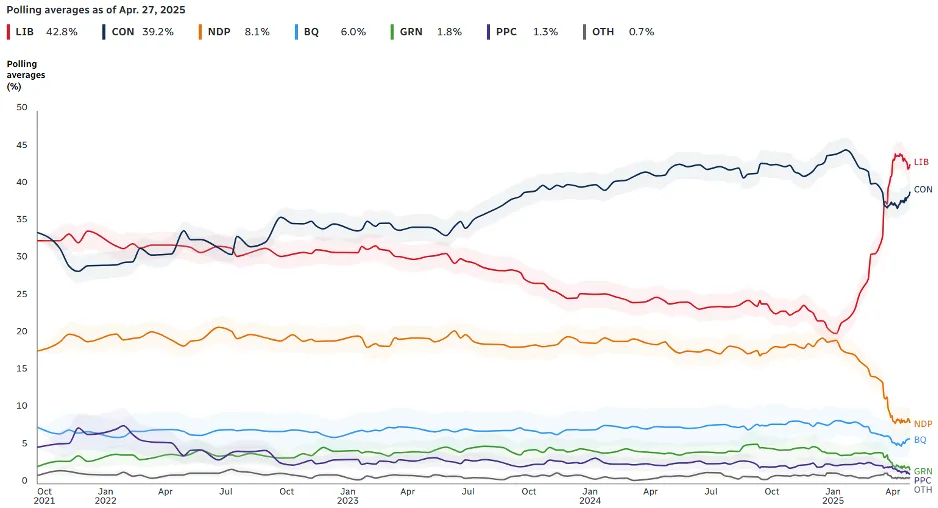
Before the re-election of Trump, the key issues for Canadian voters were the escalating cost of living, housing affordability, healthcare, and the economy.[6] Broad dissatisfaction with Trudeau of the centre-left Liberal Party propelled the opposition Conservatives to among their highest level of support on record, with Trudeau’s caucus forcing his resignation in January. [7] At the same time, the threat of tariffs and posture of Trump were met by Canadians with reactions ranging from irritation to furor.
A broad swath of tariffs against Canada entered into force on March 4.[8] As the election approached, the cost of living and the economy were reduced in their importance to voters, and Canada’s relations with the US and national identity emerged as key voting issues. Trudeau’s replacement as Liberal leader, Mark Carney, responded by adopting a set of retaliatory tariffs and centering his campaign around opposing Trump. [9] Meanwhile, the Conservatives mainly campaigned against Trudeau’s record and avoided attacking Trump out of a combination of diplomatic prudence and the affinity much of their base has for the man. The result was that Carney and the Liberals were widely seen as better able to handle Canada’s relations with the US than were the Tories.[10] Under Carney’s new leadership and thanks largely to the way Trump was handled in the campaign, the Liberals engineered a marvelous turn-around, winning election to just short of a majority government.[11]
Down under, almost the exact same scenario played out in Australia. The incumbent Labour government was threatened by long-standing low poll numbers vis-à-vis the centre-right Liberal-National Coalition ahead of the country’s May 3 federal election. [12] However, with US tariffs against Australia enacted on April 5, the political landscape sharply shifted. The Labour government did not introduce retaliatory tariffs as in Canada, but it did unveil a campaign policy to counteract them. Coalition leader Peter Dutton, who had previously praised Trump and said he had more in common with Trump than Labour leader Anthony Albanese, later distanced himself from the US President.[13] Additionally, a Christmas photo of a key Coalition senator wearing a MAGA cap became a campaign football for Labour. [14] Not only did the Coalition start bleeding support to Labour, but a poll released during the campaign showed Australians’ trust in the US had fallen 20 points since Trump’s inauguration to its lowest level on record. [15] As in Canada, Labour reversed their fortunes to deliver an upset, winning a large majority in Parliament.[16]
A World Restored
Despite these two spring electoral shocks in Western allies, more recent electoral evidence suggests the Trump tariffs are being absorbed and American antipathy is losing relevance in foreign democracies. In South America in October, the two candidates who advanced to the run-off of Bolivia’s presidential election were a Christian democrat and a conservative liberal, thereby ending two decades of presidential rule by the anti-American socialist bloc. One week later, legislative elections in Argentina – a major US ally – resulted in a decisive victory for the right-wing coalition of outspoken Trump supporter President Javier Milei. [17] Finally, the Chilean presidential election in December saw a sweeping victory for the right-wing candidate against his Communist opponent. [18] All three countries have been subject to substantial US tariffs since Trump took office. These elections therefore indicate an ebbing of foreign tension toward the US, in particular in the critical domain of electoral outcomes.
In Europe, Vice President J.D. Vance’s speech at February’s Munich Security Conference made headlines across news outlets in EU and NATO ally countries, but the trend on the Old Continent is the same as in South America. Portugal’s legislative election in May resulted in the two biggest parties that emerged being the Christian democrats and the national conservatives. [19] In Poland’s presidential election in June, a new president aligned with right wing forces, and not with Prime Minister and Trump-opponent Donald Tusk (who in 2018 famously tweeted, “With friends like [Trump], who needs enemies?”) was elected. [20] Similar results followed in the Czech Republic, while the Dutch election of October was fought on domestic issues. [21] Looking into the future, domestic support for “Europe’s Trump whisperer” Georgia Meloni and her coalition in Italy remains strong, likewise in the UK for upstart Reform and Trump apologist Nigel Farage. Finally in Asia, soon after her historic victory, new Japanese Prime Minister Sanae Takaichi joined Trump on stage at a rally for American troops aboard the U.S.S. George Washington. What all this points to is that the spring election results in Canada and Australia, while significant, did not usher in a new era of anti-American politics across the Western alliance despite the ongoing tariffs.
Renovatio
After the Second World War, American policymakers built a global alliance system with the US as its hub to counter the expansionist Soviet Union. The dramatic effect of the Trump tariffs, understood as antagonistic by Canada and Australia, resulted in electoral upheavals. Depending on the county’s political culture, future dramatic shifts of US policy could well have similar effects, particularly if occurring close to an election and coupled with sharp rhetoric.
However, the US share of global GDP was approximately 50% in the immediate postwar years, yet it is only 15% in 2025.[22] The ongoing off-loading of US international commitments – notably in Europe – make conspicuous outcomes like the ones in Canada and Australia decreasingly probable in the future.
At the same time, because of the enduring strength of American scientific-industrial resources, its unmatched university sector, its economic capacity, and its global military and naval reach, the US remains a global superpower.[23] The consequence is that US relations will remain a factor in the domestic politics of foreign countries for generations. Evidence from 2025 suggests that the type of factor depends on the policies at play and the domestic political culture of the country. In France, for example, parties across the spectrum have always distanced themselves from the US due to the nation’s mission for grandeur and reservation toward les Anglo-Saxons, with the result being that US relations have minimal import. By contrast, across the Channel in the home of the “Special Relationship,” leaders of Labour, the Conservatives, and Reform have all courted Trump’s favor while seeking a post-Brexit trade agreement amidst frosty UK-EU relations.
The stress the tariffs placed on the Western alliance should not be minimized. Declining trust in the US is a serious threat to American strategic aims. Yet, to posit Trump has eradicated democratic support for American global leadership does withstand expansive scrutiny. The world, particularly Europe, is adjusting to a decreased American presence, which counterintuitively may benefit American soft power in the long run. Consultation within the alliance, like what is happening on Ukraine policy, will by necessity be more common moving forward. The future of the US as leader of the Western alliance and as one of two global poles, despite fundamental retrenchment, remains the province of America’s future.
John Hennenfent is a trade, foreign investment, and competition lawyer based in Brussels. He previously worked as a public policy researcher and advisor, including to the Leader of the Opposition in Canada.
[1] John McCormick, “Trump Calls Tariffs the ‘Most Beautiful Word’,” The Wall Street Journal, Dow Jones & Company, Inc., October 15, 2024, https://www.wsj.com/livecoverage/harris-trump-election-10-16-2024/card/trump-calls-tariffs-the-most-beautiful-word--YMVPAupw4EjBRp6yobOy.
[2] Costas Pitas, “Trump vows new Canada, Mexico, China tariffs that threaten global trade,” Reuters, Thomson Reuters Corporation, November 26, 2024, https://www.reuters.com/world/us/trump-promises-25-tariff-products-mexico-canada-2024-11-25/.
[3] “April 3: President Trump enacts sweeping tariffs on all trading partners,” US tariffs: What’s the impact on global trade and the economy?, J.P. Morgan Global Research, JPMorgan Chase & Co., accessed February 16, 2026, https://www.jpmorgan.com/insights/global-research/current-events/us-tariffs.
[4] “Australia,” Office of the U.S. Trade Representative, accessed February 16, 2026, https://ustr.gov/countries-regions/southeast-asia-pacific/australia.
[5] “Trump: Making Canada the 51st state is a ‘great idea’,” Politico, Axel Springer SE, accessed February 16, 2026, https://www.politico.eu/article/us-donald-trump-says-great-idea-to-make-canada-the-51st-state-justin-trudeau/.
[6] Abacus Data, What is Motivating Voting Preferences in Canada? - Abacus Data.
[7] Brian Platt and Thomas Seal, “Trudeau Resigns After Nine Years in Power as Liberals Force Him Out,” Bloomberg News, Bloomberg L.P., January 6, 2025, https://www.bloomberg.com/news/articles/2025-01-06/trudeau-resigns-after-nine-years-in-power-as-liberals-force-him-out, and Mickey Djuric, “Majority of Justin Trudeau’s caucus calls on him to quit,” Politico, Axel Springer SE, December 31, 2024,
https://www.politico.com/news/2024/12/31/justin-trudeau-canada-liberals-support-00196165.
[8] “Canada announces new countermeasures in response to tariffs from the United States of America,” Office of the Prime Minister of Canada, April 3, 2025, https://www.pm.gc.ca/en/news/news-releases/2025/04/03/canada-announces-new-countermeasures-response-tariffs-from-united-states.
[9] Mickey Djuric, “Mark Carney unveils a plan to Trump-proof Canada,” Politico, Axel Springer SE, April 19, 2025, https://www.politico.com/news/2025/04/19/mark-carney-unveils-plan-to-trump-proof-canada-00299654.
[10] “Conservatives Lead as Best Party to Deal With Economic Issues,” Ipsos, April 13, 2025, https://www.ipsos.com/sites/default/files/ct/news/documents/2025-04/2025%20Federal%20Election_Week_3_Top_Issues_April%2011%202025_FINAL_V2.pdf.
[11] Alicja Hagopian, “Canada’s election in numbers: How Mark Carney’s Liberals won power in Trump’s shadow,” The Independent, Independent Digital News & Media Ltd, April 30, 2025, https://www.independent.co.uk/news/world/americas/canada-election-votes-mark-carney-b2742140.html.
[12] “Labor v the Coalition: political opinion poll tracker,” The Guardian, Guardian Media Group, accessed February 16, 2026, https://www.theguardian.com/australia-news/ng-interactive/2025/may/02/australia-election-polls-latest-aus-opinion-poll-tracker-results-current-polling-survey-labor-vs-liberal-dutton-albanese.
[13] Michelle Grattan and Peter Dutton, “Peter Dutton on why he’s not Australia’s Trump – ‘I’m my own person’,” March 13, 2025, in Politics with Michelle Grattan, produced by The Conversation, podcast, MP3 audio, 45:49, https://podcasts.apple.com/us/podcast/peter-dutton-on-why-hes-not-australias-trump-im-my-own-person/id703425900?i=1000699072160&l=zh-Hans-CN.
[14] Padraig Collins and Zak Wheeler, “Glaring detail in photo of top Liberal senator that will be giving Peter Dutton a headache,” Daily Mail, DMG Media, April 14, 2025, https://www.dailymail.co.uk/news/article-14605399/Jacinta-Price-MAGA-hat-Coalition-Trump-Dutton-election.html.
[15] “Australians’ trust in the United States drops to a new low and Albanese leads Dutton on foreign policy,” Lowy Institute, April 16, 2025, https://www.lowyinstitute.org/australians-trust-united-states-drops-new-low-albanese-leads-dutton-foreign-policy.
[16] Charles Edel, “Australia’s 2025 Election: Decisive Labor Majority Amid Liberal Collapse,” Center for Strategic and International Studies, May 5, 2025, https://www.csis.org/analysis/australias-2025-election-decisive-labor-majority-amid-liberal-collapse.
[17] “Argentina’s midterm election hands landslide win to Milei’s libertarian overhaul,” Reuters, CNBC, October 26, 2025, https://www.cnbc.com/2025/10/27/argentinas-midterm-election-hands-landslide-win-to-mileis-libertarian-overhaul.html.
[18] “Landslide win for Kast gives Chile its most right-wing president in decades,” The Associated Press, NBC News, December 15, 2025, https://www.nbcnews.com/world/chile/landslide-win-kast-gives-chile-right-wing-president-decades-rcna249263.
[19] José Santana Pereira and Guya Accornero, “2025 legislative elections in Portugal: A tale of three poles,” The database of WHO governs in Europe and beyond, University of Nottingham, May 30, 2025, https://whogoverns.eu/2025-legislative-elections-in-portugal-a-tale-of-three-poles/.
[20] Matt Boyse, “Nawrocki victory shakes up Polish politics,” GIS Reports, Geopolitical Intelligence Services AG, August 6, 2025, https://www.gisreportsonline.com/r/poland-presidential-election/.
[21] Jelle Fastenau and Welmoed van den Bergh, “Klimaat minder belangrijk voor kiezers dan bij de vorige verkiezingen, ook politiek minder aandacht,” EenVandaag, September 22, 2025, https://eenvandaag.avrotros.nl/opiniepanel/uitslagen/klimaat-minder-belangrijk-voor-kiezers-dan-bij-de-vorige-verkiezingen-ook-politiek-minder-aandacht-161406.
[22] “United States' share of global gross domestic product (GDP) adjusted for purchasing power parity (PPP) from 2020 to 2030,” Statista, accessed February 17, 2026, https://www.statista.com/statistics/270267/united-states-share-of-global-gross-domestic-product-gdp/?srsltid=AfmBOooFKpVxdrDY9q1w1VPg1S7Slo13qRRHK0QyN-4SwGaMVzD8Syvp.
[23] Paul Kennedy, “The Rise and Fall of the Great Powers redux,” The New Statesman, September 20, 2023, https://www.newstatesman.com/ideas/2023/09/rise-and-fall-of-great-powers-redux-paul-kennedy.