
Making the 15-Minute City Work in Southeast Asia: A Gender-responsive Approach to Urban Planning
Rapid urbanization in Southeast Asia calls for new approaches to building more livable and inclusive cities. The 15-minute city offers a useful reference point for rethinking urban accessibility, but it is not a universal model. Adapting its principles through gender-responsive planning can help address unequal access to services, strengthen inclusive governance, and better integrate informal economies.
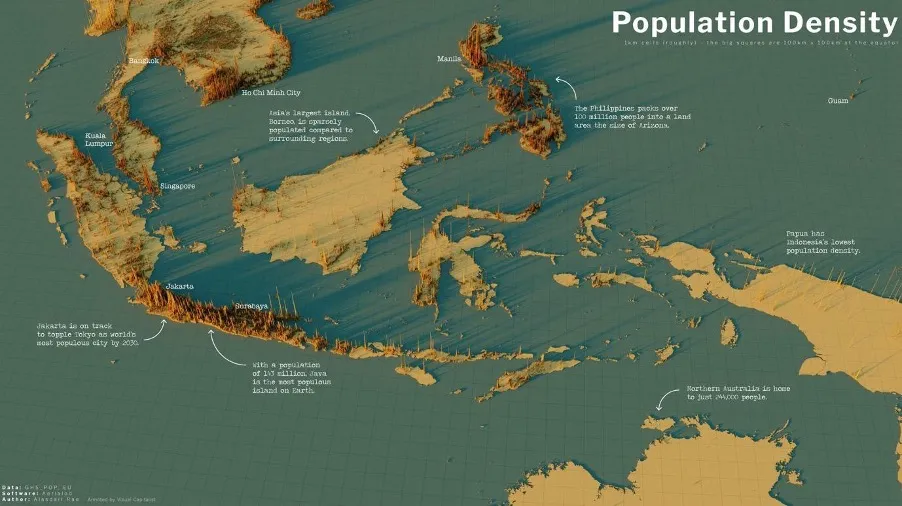
The majority of the world’s population lives in cities[1]. In Southeast Asia, urban bubbles are home to approximately one-third of the region's population, yet they contribute to around two-thirds of overall economic activity with a staggering 70 million more projected to join the city life by 2025 – a number exceeding the combined population of all ASEAN capitals today[2]. Southeast Asian cities are growing at a rapid pace, but can urban planning catch up to the diverse needs of everyone living in them? In response to evolving urban challenges, new frameworks like the concept of a 15-minute city are redefining how to design and build functional communities.
The 15-minute city is an urban planning model that promotes more livable and sustainable cities[3]. It is an ambitious but promising approach to creating more people-centered urban environments. Developed by Sorbonne University Professor Carlos Moreno, the idea behind 15-minute cities is to ensure that essential services and resources, such as healthcare, job opportunities, education, food, and transportation, are within a 15-minute walk or bike ride from people's homes. It provides a solution to reduce a heavy reliance on cars and allows for more freedom in how inhabitants choose to spend their time.
This model reimagines an ideal city where residents’ can easily meet their everyday needs within a close perimeter, enabling a greener and more convenient way of living. This ultimately enhances the overall quality of life for its residents and communities; however, promoting self-sustaining local spaces is not only a question of how to future-proof cities but also how to make them more inclusive in the long run.
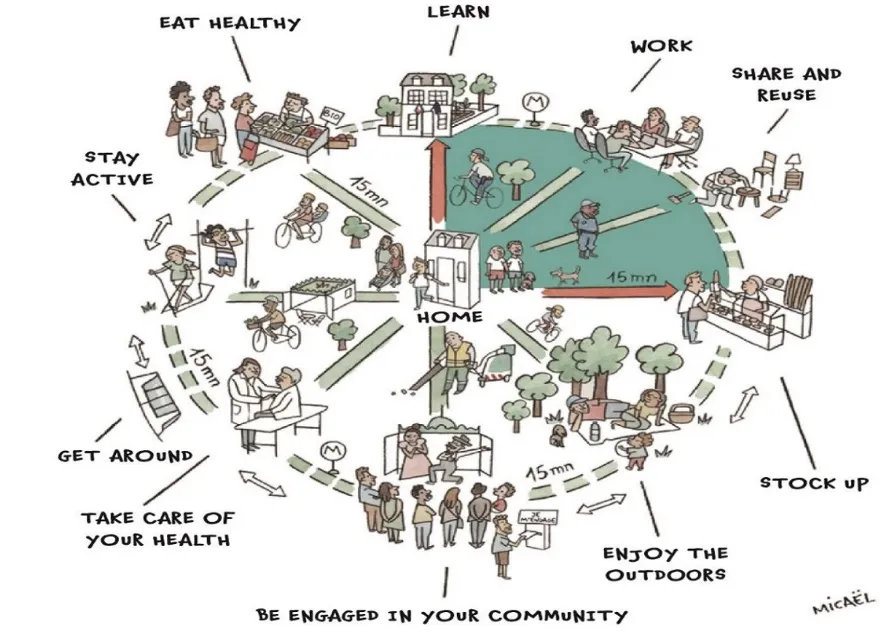
Cities are currently at a crossroads, requiring a fundamental redesign to meet the needs of a changing world. With Southeast Asia witnessing a rapid and widespread urban boom, policymakers and urban planners are presented with the opportunity to build cities that work better for everyone, especially for women who often bear the brunt of poorly designed urban spaces[4]. Many cities were originally built to support the traditional workforce, overlooking the different and specific ways women use and experience public spaces[5]. The 15-minute city concept holds immense potential to improve lives for everyone in Southeast Asia, but its success hinges on building truly inclusive urban environments.
Mainstreaming gender in urban planning means understanding different needs, lifestyles, and interests while intentionally creating space to incorporate all of these into cities that are worth living in[6]. As this new urban design paradigm gains traction worldwide, it provides a compelling framework for redesign that addresses gaps in existing city plans and modernizes urban spaces to reflect the needs of its people. There are three key strategies that can guide urban planners taking on this gender-responsive transformation:
1. Participatory processes and inclusive urban planning
Traditional top-down urban planning often overlooks the diverse needs of its residents, especially marginalized groups like women and girls. Historically, women have been excluded from land ownership and management and this manifests itself today in how urban planning and design dismisses disparate impacts on marginalized groups. To address the specific challenges women face in urban environments, cities must adopt inclusive participatory processes. Actively involving women in the decision-making process allows cities to capture vital perspectives on safety, accessibility, and service provision. This involves creating safe and accessible spaces for women to participate in consultations.
Another way to empower women to participate is to consider gender quotas when forming planning and leadership committees and train participants in urban planning. Since women often plan and design with diversity in mind, supporting women participating in urban governance ensures that their needs are advocated for across all levels of local government[7]. Community-based organizations, such as women’s networks, can also play a greater role in bringing diverse perspectives into urban policies that are more grounded in the lived experiences of the community, making them more representative and impactful.
Banda Aceh stands out as one of the first cities in Indonesia to actively involve women’s voices in development planning processes which have typically been dominated by men. Through their Musrena, or Women’s Action Plan Deliberation, Banda Aceh aims to be a gender-friendly city using open forums to engage women from the village level up to higher representation, opening the widest possible space for women’s participation in the urban development process[8].
2. Tailored solutions to integrate the informal economy
In Southeast Asia, a significant portion of the workforce operates in the informal economy[9]. Women in the region generally have lower labor market participation rates compared to men, and those who are employed are more likely to be concentrated in the informal sector undertaking low-paying jobs in precarious conditions[10]. Women face disproportionate barriers to participating in the formal economy, such as the heavy burden of unpaid care work that they are expected to provide. This diminishes the time they can devote to otherwise economically productive activities. Across the ASEAN region, the unequal share of family responsibilities often prevents girls from accessing the same education and job opportunities as boys[11]. Since women and girls provide most of the household labor, they have far less time for paid work or training. This structural imbalance limits their professional growth and traps them in a cycle of reduced independence and financial disadvantage. The region’s informal economy continues to be a key policy concern as it undermines overall productivity measures[12]. Southeast Asia's dynamic urban landscapes are marked by vibrant informal economies, often driven by female entrepreneurs and workers who engage in a vast array of livelihoods: from street vending and food stalls to home-based businesses and caregiving[13]. Integrating these essential yet often overlooked actors into the 15-minute city model requires a gender-responsive approach that begins by acknowledging their contributions to the local community.
Local programs and policies can support pathways for women to transition into formal work by having designated support centers addressing their various needs at different stages. Such spaces can provide access to permits and training programs and facilitate their access to other services such as micro-credit opportunities. Urban planners can also design accessible micro-infrastructure and zoning regulations that cater to their specific needs, like flexible operating hours or designated vending zones. Along with the creation of inclusive markets and public spaces with sanitation and childcare facilities, these can serve as preliminary mechanisms for encouraging gradual integration into the formal economy.
Northern Thailand’s Chiang Rai “Inclusive Urban Development for Informal Workers” initiative serves as a best practice example for other cities in Southeast Asia seeking to integrate informal female workers into urban planning[14]. Apart from the municipality helping them with the provision of meeting spaces and increased involvement in city policy planning, the Chiang Rai local government also informs them of social security packages and courses to introduce them to more competitive markets.
3. Improve gender data collection
Lastly, underpinning these strategies is the need to improve gender data collection. Gender-disaggregated data reflects residents’ different experiences based on gender identification and cities can use this to respond to inequalities and allocate resources accordingly. Improving such gender data collection means employing gender-sensitive participatory methods (e.g. focus group discussions, interviews) as well as collecting data disaggregated by other factors like sex, age, socioeconomic status, disability, religion, ethnicity to identify intersecting inequalities. It reveals gender-based vulnerabilities and more accurate trends in women’s daily experiences, like their use of public transport, unequal access to healthcare and economic opportunities, and greater exposure to violence and disasters[15]. Gender data-driven insights reveal that urban environments are rarely neutral, as women’s mobility is shaped by both caregiving responsibilities and safety considerations.
Unlike the linear commutes typical of men, women’s travel often involves trip-chaining––linking multiple short trips to balance paid and unpaid labor. This creates a structural gender-based vulnerability since transit systems optimized for peak hours often leave women navigating times when infrequent service and isolated infrastructure increase their exposure to harassment. These risks are further magnified by climate change, as women are 14 times more likely to be harmed during disasters while facing an intensifying care burden for vulnerable children and the elderly[16]. Ultimately, when urban design and disaster response fail to account for these specific travel patterns and intersecting risks, they inadvertently restrict women’s autonomy and increase their socio-economic vulnerability.
Local government attention and investment can then be directed towards actionable outcomes such as better street lighting, public toilets and lactation spaces, and accessible transportation options. In the Philippines for example, Quezon City initially lacked systematic data on sexual violence in public spaces. Improved gender data collection in Quezon City has led to trailblazing local legislation on addressing all forms of gender-based sexual harassment (GBSH) in public spaces, defining GBSH in street and public spaces as “acts which are committed through any unwanted and uninvited sexual actions or remarks against any person regardless of the motive for committing such action or remarks.” This local success paved the way for the national legislation “Safe Spaces Act” which recognizes GBSH and imposes penalties and sanctions to enhance the rule of law against violence[17].
No One-Size-Fits-All: Localizing the 15-Minute City
It is important to recognize that the successful application of the 15-minute city is not a universal model and can differ significantly across urban contexts[18]. The concept was largely developed with European cities in mind, many of which already possess historically dense, compact, and walkable urban centers. European cities, such as Paris, have therefore come closest to achieving the basic goals of the 15-minute city. By contrast, many Southeast Asian cities have evolved through rapid and often unplanned urban expansion, resulting in sprawling metropolitan areas characterized by car-centric infrastructure and uneven access to services.
Socio-economic factors establish a complex baseline for urban planning, where economic realities often dictate the scale and feasibility of design interventions. Lower average income levels and limited social safety nets can make large-scale infrastructure investments more challenging, while growing populations, vulnerability to natural disasters, and intense climate conditions further complicate urban planning efforts across the region.
For these reasons, there is no universal model for implementing the 15-minute city. Rather than replicating a European blueprint, Southeast Asian cities may benefit from adapting the concept to their own realities and priorities. Placing vulnerable neighborhoods at the center of urban strategies can help cities address long-standing spatial and social inequalities while improving access to essential services. In practice, expanding the timeframe to a 30-minute accessibility radius may offer a more realistic benchmark in large and densely populated metropolitan areas[19]. In cities such as Manila, Kuala Lumpur, and Bangkok, ensuring that residents can reach at least one key healthcare facility or education center within this timeframe can represent meaningful progress toward more equitable urban service provision.
Ultimately, the 15-minute city should be understood less as a rigid framework and more as a starting point for rethinking how cities are designed and experienced. Its emphasis on proximity, accessibility, and livability can provide valuable guidance for policymakers seeking to build more inclusive urban environments. However, it must be adapted to local cultural, economic, and spatial contexts for the concept to be truly effective in Southeast Asia. When approached through a gender-responsive lens, the idea of proximity can help planners better understand the everyday mobility patterns and care responsibilities that shape women’s lived experiences, allowing urban strategies to respond more directly to the needs of diverse communities.
Stacey Nicole Bellido is a Filipina policy professional based in Paris working at the intersection of gender equality, inclusive development, and EU–ASEAN relations. Her work spans policy research, international advocacy, and partnership-building across multilateral institutions and public sector organizations, including the OECD, ICC, ILO, and the Philippine Department of Foreign Affairs.
[1] UN Habitat. “Gender Issue Guide Urban Planning and Design.” United Nations Human Settlements Programme, 2012. https://unhabitat.org/sites/default/files/download-manager-files/Gender%20Responsive%20Urban%20Planning%20and%20Design.pdf.
[2] Lee, Gillian, Penny Burtt, Fraser Thompson, Oliver Tonby, and Jonathan Woetzel. “Southeast Asia at the Crossroads: Three Paths to Prosperity.” McKinsey Global Institute, November 2014. https://www.mckinsey.com/~/media/mckinsey/featured%20insights/asia%20pacific/three%20paths%20to%20sustained%20economic%20growth%20in%20southeast%20asia/southeast_asia_at_the_crossroads_three_paths_to_prosperity_full%20report.pdf; Sharif, Maimunah Mohd. “Capturing the Urban Opportunity in Southeast Asia.” The Road to Sustainable Cities. ASEAN, 2021. https://asean.org/wp-content/uploads/2021/08/The-ASEAN-Sustainable-Cities-June-July-2021.pdf.
[3] Bruno, Davide Maria, Guido Musante, and Fabio Dacarro. “Materials for a Debate on the 15-Minute City: Public Transportation’s Effect on Urban Space and Time in Two Asia-Based Alternative Proposals.” Journal of Asian Architecture and Building Engineering 23, no. 6 (December 2023): 2134–56. https://doi.org/10.1080/13467581.2023.2287223.
[4] Sharif, Maimunah Mohd. “Capturing the Urban Opportunity in Southeast Asia.” The Road to Sustainable Cities. ASEAN, 2021. https://asean.org/wp-content/uploads/2021/08/The-ASEAN-Sustainable-Cities-June-July-2021.pdf.
[5] UN Habitat. “Gender Issue Guide Urban Planning and Design.” United Nations Human Settlements Programme, 2012. https://unhabitat.org/sites/default/files/download-manager-files/Gender%20Responsive%20Urban%20Planning%20and%20Design.pdf.
[6] Uken, Sybille, Cagla Ilk, Susanne Hofmann, Pamela Dorsch, Anna Damrat, Anke Schröder, Sandra Huning, et al. “Gender Mainstreaming in Urban Development Berlin Handbook.” Senate Department for Urban Development, Building and Housing, July 2011. https://civitas.eu/sites/default/files/berlin_gender_mainstreaming_0.pdf.
[7] Williams, Rhiannon, Spencer Robinson, Jess Jones, Rishi Chakraborty, Ider Batbayar, Kim Power, and Sara Candiracci. “Cities Alive: Designing Cities That Work for Women.” UNDP, October 20, 2022. https://www.undp.org/publications/cities-alive-designing-cities-work-women.
[8] “Musrena.” Bappeda Kota Banda Aceh, February 9, 2017. https://bappeda.bandaacehkota.go.id/program-strategis/musrena/.
[9] Sciortino, Rosalia. “Informal Workers in Southeast Asia: Resourceless, yet Resourceful.” WIEGO, March 7, 2025. https://www.wiego.org/blog/informal-workers-southeast-asia-resourceless-yet-resourceful/.
[10] Tinning, Cecilia, Eunkoo Lee, Sneha Kaul, Woojoo Hong, Tsz Yu Chang, and Sara Duerto-Valero. “ASEAN Gender Outlook 2024.” ASEAN Gender Outlook, 2024. https://data.unwomen.org/sites/default/files/documents/Publications/2024/ASEAN-gender-outlook_2024.pdf.
[11] “Women’s Economic Empowerment and the Care Economy in ASEAN.” UN Women, 2024. https://asiapacific.unwomen.org/sites/default/files/2024-08/ap-c1094-240820-unwwee-careeconomy-asean.pdf.
[12] “OECD Skills Strategy Southeast Asia.” OECD Skills Studies, March 22, 2023. https://doi.org/10.1787/923bfd03-en.
[13] Jun, Heekyung, Marta Bertanzetti, and Max Bulakovskiy. “Women Entrepreneurship in Remote Areas in Indonesia and the Philippines.” OECD Global Relations Policy Papers, 2025. https://www.oecd.org/content/dam/oecd/en/publications/reports/2025/09/women-entrepreneurship-in-remote-areas-in-indonesia-and-the-philippines_d07a3bbe/05c6e827-en.pdf.
[14] Cities Alliance. Realizing Gender-Equality in Cities. Brussels, Belgium: Cities Alliance, 2019. https://www.citiesalliance.org/sites/default/files/2019-08/CA_Gender_Mainstreaming_Brochure.pdf.
[15] Spinardi, Anna, Agustina Pérez Mirianco, Francesca Perucci, and Jahanara Saeed. “Feminist Urban Design: A Gender-Inclusive Framework for Cities.” Cities Change, n.d. https://www.citieschange.org/resources/feminist-urban-design-a-gender-inclusive-framework-for-cities/.
[16] Spinardi, Anna, Agustina Pérez Mirianco, Francesca Perucci, and Jahanara Saeed. “Feminist Urban Design: A Gender-Inclusive Framework for Cities.” Cities Change, n.d. https://www.citieschange.org/resources/feminist-urban-design-a-gender-inclusive-framework-for-cities/.
[17] “Creating Safe Public Spaces.” UN Women - Asia and the Pacific. Accessed April 24, 2026. https://asiapacific.unwomen.org/en/focus-areas/end-violence-against-women/creating-safe-public-spaces.
[18] Luca, Oana, and Emanuel Răuță. “Urban Proximity and Social Justice. Insights from Romania for the 15-Minute City Debate.” Journal of Urbanism: International Research on Placemaking and Urban Sustainability, October 16, 2025, 1–3. https://doi.org/10.1080/17549175.2025.2574069.
[19] Wang, Hui, Ka Ho Tsoi, and Becky P.Y. Loo. “An Assessment Framework for 15-Minute Cities: Progress Worldwide and the Impact of Urban Form.” Transportation Research Part A: Policy and Practice 199 (September 2025): 104583. https://doi.org/10.1016/j.tra.2025.104583.