
U.S.-China Security Relations Set for Four More Years of Stability
U.S.-China Security Relations will likely remain stable over the next four years. While Trump’s strategic retrenchment represents a shift from Biden’s alliance-focused strategy toward offshore balancing, neither country is prepared for instability. However, both countries are gambling with stability over the next four years. Trump’s approach prioritizes economic competition with China while encouraging regional allies to assume greater defensive responsibilities. The success of this strategic transition hinges on a delicate balance between allied capability development and the credibility of American security guarantees.
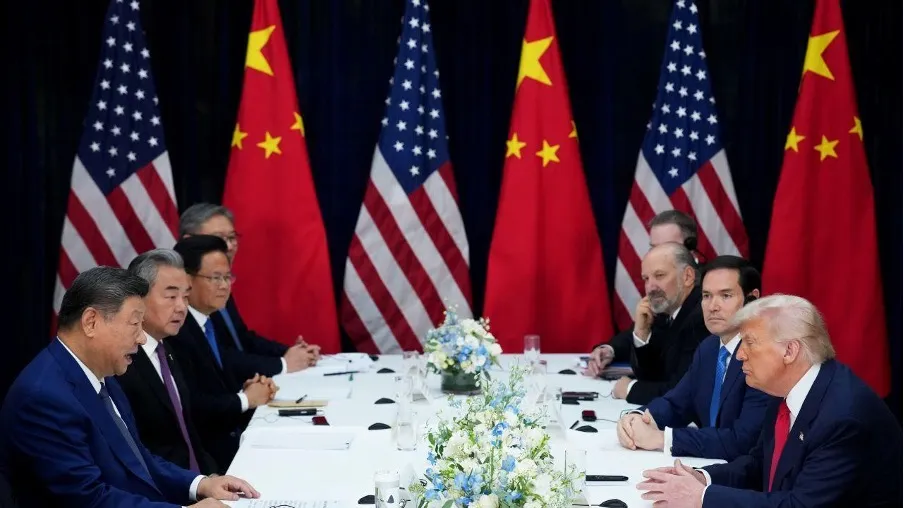
Upon Donald Trump’s presidency, U.S.-China security relations are likely to experience four years of increased stability. During his first year in office, Trump has notably refrained from making provocative statements on Taiwan—the most sensitive issue in U.S.-China relations. The 2025 National Security Strategy frames China primarily through an economic rather than military-confrontational lens. While identifying the Indo-Pacific as a central geopolitical battleground and pledging to maintain military capabilities to “deny aggression anywhere in the First Island Chain,” the document maintains traditional U.S. declaratory policy on Taiwan, explicitly stating opposition to “any unilateral change to the status quo in the Taiwan Strait.” Instead of clarifying current security tension related to Taiwan, the strategy’s treatment of China focuses extensively on rebalancing what it characterizes as three decades of “fundamentally unbalanced” commercial relations. 1 Notably, this economic emphasis coincides with the strategy’s elevation of the Western Hemisphere as a priority theater, announcing a “Trump Corollary to the Monroe Doctrine” aimed at denying external powers influence in the Americas—a geographic reorientation that may signal reduced appetite for direct confrontation with China in distant theaters. 2
This aligns with the expectations of many realists in the field of foreign policy who advocate for a retrenchment strategy.3 Such a strategy refocuses American resources and diplomatic attention on the Western Hemisphere. The 2025 National Security Strategy explicitly declares that “the days of the United States propping up the entire world order like Atlas are over” and prioritizes shifting burdens to allies while reducing commitments in “theaters whose relative import to American national security has declined.” 4
Alliance politics represents a crucial approach to addressing threats, preventing adversaries from gaining power through expansion, whether territorial or otherwise. However, direct engagement and alliance-building lead to sustained resource-depleting confrontations with adversaries. Strategic retrenchment offers an alternative approach to addressing threats, essentially transferring the costs of containment to other great powers, retrenching from resource-depleting confrontations while simultaneously containing China’s potential and cultivating America’s own potential.
Both Trump’s America First policy or his transnational diplomacy aim to shift the costs of balancing power from the U.S. to its regional allies.5 This approach is explicitly articulated in the NSS through its “burden-sharing and burden-shifting” framework, which declares that regional allies “assume primary responsibility for their regions” and calls for “pressing our First Island Chain allies and partners” to invest in deterrence capabilities, thereby transforming U.S.-China competition into broader multilateral balancing. 6 This particularly depends on Asian allies who reject China’s hegemonic ambitions and resist integration into any China-led regional order. For instance, Japan has never considered integrating into a China-led regional order.7 Historically, Japan’s supreme rulers have long called themselves ‘tennō’ (Emperor), a title that transgressed the hierarchical order of the tributary system and implied equality in status to the Chinese Emperor.8 As China’s power rises, Japan perceives growing security challenges stemming from unresolved territorial disputes over the Senkaku/Diaoyu Islands, competing claims regarding freedom of navigation in regional waters, and divergent positions on Japan’s potential role in the issue of Taiwan. Thus, it is reasonable for the U.S. to shift primary balancing responsibilities to Japan. From a realist perspective, any concession in the Taiwan Strait or the Korean Peninsula would severely undermine Japan’s security, leaving it isolated as a lone island in the Pacific. Therefore, many minilateral security architectures emerge under this context, with Japan as the core pillar.9
However, Japan alone cannot support the stability of the security architecture. South Korea, while not rejecting China’s regional order framework, is constrained by security concerns on the Korean Peninsula.10 As a result, East Asia’s minilateral security architecture remains underdeveloped, and the U.S. will not fully retrench from the region if it seeks to restore a regional balance of power through regional powers. While continuing Biden-era policies and maintaining security relationships with allies, Trump is further demanding that Japan increase its defensive spending.11 Building on Biden, Trump will encourage allies to take on more defensive responsibilities while avoiding actual conflict with China.12 Defense Secretary Pete Hegseth emphasized at the December 2025 Reagan Defense Forum that the United States seeks to “deter China through strength, not confrontation.” 13
Trump has a grand vision of transferring the responsibility of containing China to regional powers through strategic retrenchment while rebuilding America’s industrial and trade potential. His “America First” policy framework that prioritizes domestic economic revitalization, with foreign investment from Asian and Middle East allies, and demands greater allied burden-sharing in defense commitments. However, his strategy depends on two critical factors: capability and time. Currently, regional powers lack the capability to fully contain China independently, and the U.S. needs to exercise more patience and allow more time for two strategic developments. First, enabling neighboring countries to form collaborative alliances that can effectively counter Chinese influence. Second, ensuring that regional powers develop sufficient capabilities to transform any regional conflict into a protracted war of attrition that China cannot easily win. As of now, Japan and South Korea are making substantial progress toward these objectives. Japan is rapidly expanding its deterrence posture through unprecedented defense reforms, including the deployment of anti-ship missile systems across its southwestern island chain and joint development programs with the U.S.14 for intermediate-range ballistic missiles. Tokyo is simultaneously working to enhance the flexibility and permanence of access, basing, and overflight arrangements that enable distributed American military operations throughout the Indo-Pacific theater. Seoul is also investing heavily in defense industrial modernization, positioning itself as an increasingly capable partner in collaborative military construction projects and complementary defense technologies. 15
China won't remain passive either. As China’s capabilities and influence expand, neighboring countries may choose band wagoning. In the worst scenario for the U.S., its Indo-Pacific allies may accommodate Chinese regional dominance rather than risk the costs of military confrontation with Beijing. Thus, the key challenge for Trump’s strategic retrenchment in the future will be how to avoid a hard landing if Asian allies fail to take on a more active role in the region. Currently, both India and Japan are adopting a gradual approach to enhancing their own power through increased defense spending, indigenous weapons development including Japan’s acquisition of Tomahawk cruise missiles and extended-range Type 12 missiles, and India’s focus on domestic procurement and emerging technologies like artificial intelligence and cyber capabilities. 16
In addition to foreign policy, America’s key domestic interests are closely tied to China. The trade and economic positions in Trump’s cabinet suggest that high inflation and national debt will be his primary concerns.17 Therefore, his trade war with China will inevitably return to the negotiating table in order to maximize mutual benefits. Trade negotiations will not lead to security conflicts between the U.S. and China in the Indo-Pacific as Trump’s strategy treats economic competition and military deterrence as separate policy tracks—pursuing commercial deals to rebuild American manufacturing while simultaneously relying on allied burden-sharing and forward military presence to maintain the regional balance of power, thereby avoiding the need for direct U.S.-China military confrontation that could disrupt profitable trade relationships. Further, Trump’s transactional diplomacy may provide an opportunity for the U.S. and China to reach a consensus.
Neither the U.S. nor China wants to directly engage in conflict with each other. The U.S. and China are still at the negotiating table in the trade war, with both sides facing their own economic and social vulnerabilities, necessitating compromise on trade issues. Neither power is prepared for the instability brought by this four-year term, nor have its Indo-Pacific allies developed sufficient capacity to contain China’s rise, while China’s economy remains unready for military confrontation with its neighbors.
Xuehan Shang holds a Master of Arts in International Relations from the University of Chicago. She has been working as a policy analyst in the private sector since 2024, focusing on U.S.-China relations. Her research centers on Japan studies and East Asian security.
Di Lu holds a Master of Arts in International Relations from the University of Chicago. Since 2022, he has worked as a policy analyst specializing in grand strategy, trade policy, and supply chain resilience. His research interests are in the fields of international relations theory and Chinese foreign policy. His research has been published in journals like International Politics.
1. The White House. National Security Strategy of the United States of America. Washington, DC: The White House, November 2025.
2. The White House. “America 250: Presidential Message on the Anniversary of the Monroe Doctrine.” December 2, 2025. https://www.whitehouse.gov/presidential-actions/2025/12/america-250-presidential-message-on-the-anniversary-of-the-monroe-doctrine/.
3. John Laidler. “Memo to America: Not Everyone Wants to Be like You.” Nation & World. Harvard Gazette (Cambridge, Massachusetts). November 6, 2018. https://news.harvard.edu/gazette/story/2018/11/harvard-professor-stephen-walt-urges-shift-in-u-s-foreign-policy/.
4. The White House. National Security Strategy of the United States of America. Washington, DC: The White House, November 2025.
5. Joseph S. Nye Jr. “Trump’s Transactional Myopia.” The Strategist (ASPI). February 5, 2020. https://www.aspistrategist.org.au/trumps-transactional-myopia/.
6. The White House. National Security Strategy of the United States of America. Washington, DC: The White House, November 2025.
7. Naoki Sakai. “Rethinking the Meiji Restoration.” Engelsberg Ideas. March 5, 2021. https://engelsbergideas.com/essays/rethinking-the-meiji-restoration/.
8. Adriana Boscaro et al. Rethinking Japan Vol 2: Social Sciences, Ideology and Thought. vol. 2 (Routledge, 2018). https://doi.org/10.4324/9781315060316.
9. Gabriel Dominguez. “As U.S. ‘Minilateral’ Diplomacy Grows, Japan Emerges as Key Actor.” Analysis, The Japan Times (Japan). August 6, 2024. https://www.japantimes.co.jp/news/2024/08/06/japan/politics/asia-us-minilaterals-japan/.
10. Simon Hutagalung. “South Korea’s Security Challenges In 2025: Balancing Military, Diplomacy, And Economy – OpEd.” Opinion, Eurasia Review. March 21, 2025. https://www.eurasiareview.com/21032025-south-koreas-security-challenges-in-2025-balancing-military-diplomacy-and-economy-oped/.
11. Jesse Johnson. “Trump Pentagon Policy Pick Pushes Japan and Taiwan to Boost Defense Spending.” Politics, The Japan Times. March 5, 2025. https://www.japantimes.co.jp/news/2025/03/05/japan/politics/pentagon-japan-defense-spending/.
12. Michael Beckley et al. “Trump’s Second Term: Charting a New Path in Asia - Foreign Policy Research Institute.” Expert Commentary, Foreign Policy Research Institute, n.d. accessed November 30, 2025. https://www.fpri.org/article/2025/01/trumps-second-term-charting-a-new-path-in-asia/.
13. “Hegseth Says ‘Special Favor’ for ‘Model Allies’ like S. Korea, Consequences for Those Failing to Do Their Part.” The Korea Times. December 7, 2025. https://www.koreatimes.co.kr/foreignaffairs/20251207/hegseth-says-special-favor-for-model-allies-like-s-korea-consequences-for-those-failing-to-do-their-part.
14. “Japan’s Improved Land-Based Type 12 Missile Completes U.S. Tests for Extended Naval Deterrence.” Army Recognition. December 19, 2025. https://www.armyrecognition.com/news/army-news/2025/japans-improved-land-based-type-12-missile-completes-u-s-tests-for-extended-naval-deterrence.
15. “Seoul-Washington Alliance Drives South Korea’s Resilience.” Indo-Pacific Defense FORUM. December 16, 2025. https://ipdefenseforum.com/2025/12/seoul-washington-alliance-drives-south-koreas-resilience/.
16. “Make in India Powers Defence Growth.” Government of India Press Information Bureau. February 2025. https://www.pib.gov.in/PressReleaseIframePage.aspx?PRID=2114546.
17. Josh Boak and Fatima Hussein. “Rising National Debt Is a Risk for Trump’s Economic Promises on Growth and Inflation.” Politics, AP News. November 24, 2024. https://apnews.com/article/trump-national-debt-inflation-economic-growth-spending-895ec1551122a0e1babf24b657f650bb.