
One Year In: Trump’s Nuclear Weapons Record and Opportunities for Change
Despite intermittent rhetorical support for “denuclearization,” U.S. President Trump’s nuclear weapon policies, during both his first term and the first year of his second term, have only increased nuclear risks. Rather than hoping for the U.S. President to lead on disarmament, the global community should heed the leadership of the majority of the world’s governments. Through the Treaty on the Prohibition of Nuclear Weapons, which as of 2025 has been signed or ratified by 99 UN member states (50.3% of those eligible to do so), the international community is bolstering norms against nuclear weapons and building a viable framework for their elimination.
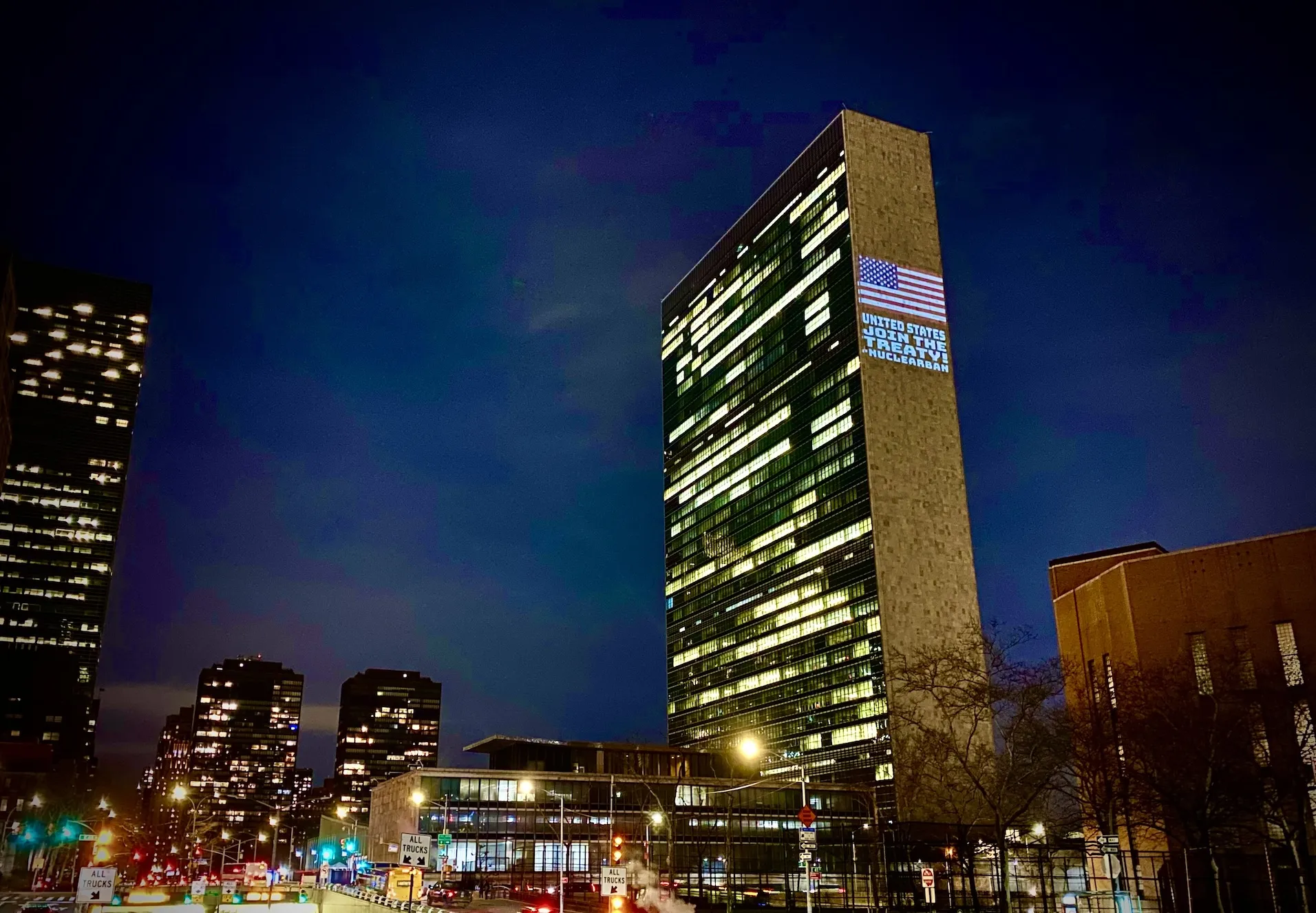
When Donald Trump began his second term, risks of nuclear catastrophe were already at an all-time high.[1] One year in, Trump has made the world even more precarious. Yet, several analysts, noting that Trump has expressed commitments to nuclear disarmament throughout his life, have asked whether Trump might nevertheless chart a new course toward a world without nuclear weapons.
Historically, progress on disarmament and arms control has indeed advanced in unlikely times.[2] A summit between Ronald Reagan and Mikhail Gorbachev at the height of the Cold War paved the way for significant arms reductions, for example, and nearly led to complete nuclear disarmament.[3]
But rather than relying on Trump’s rhetoric, we must look toward the leadership of the majority of the world’s countries on the Treaty on the Prohibition of Nuclear Weapons (TPNW). The TPNW is the only globally-applicable treaty that categorically bans nuclear weapons. The countries that have joined TPNW are designing a pathway toward a safer future for the world.[4]
Trump’s Rhetoric and Actions on Nuclear Disarmament
President Trump’s comments in support of “denuclearization” at the January 2025 Davos Economic Forum continued a decades-long pattern of Trump’s expressed concern about the dangers of nuclear war and interest in nuclear disarmament.[5] In 1984, Trump told a Washington Post reporter that he wanted to negotiate nuclear arms control with the Soviet Union on behalf of the U.S., and, in 1986, he reportedly contacted the International Physicians for the Prevention of Nuclear War after they won the Nobel Peace Prize for raising awareness of the consequences of nuclear war.[6] In a 1990 interview, Trump called nuclear weapons the "ultimate catastrophe," similar to comments he has made more recently, including during his presidential campaigns.[7]
However, Trump’s actions in the first year of his second term have thwarted national and international disarmament progress and undermined global non-proliferation goals as well. In Trump’s first term, his Administration issued a Nuclear Posture Review (NPR) seeking to expand the U.S. nuclear arsenal and reject arms control agreements.[8] His new National Security Strategy, issued in November 2025, merely states the objective to obtain “the world’s most robust, credible, and modern nuclear deterrent.”[9] Project 2025, meanwhile, calls for production of even more new types of nuclear weapons and resumption of nuclear weapon testing, which the U.S. halted in 1992.[10] Given that many current and former Trump Administration employees wrote it, Project 2025 may provide an indication of some of the policies Trump will pursue.
Many of Trump’s actions on nuclear weapons thus far have aligned with Project 2025 proposals, or otherwise signal increased reliance on nuclear weapons and deterioration of the global non-proliferation regime.[11] A January 2025 Executive Order to build “the Iron Dome of America” missile defense system is not only technologically infeasible and exorbitantly expensive, but also threatens to prompt nuclear arms racing, as adversaries develop new nuclear weapons systems designed to evade any new defense.[12] In March 2025, in open defiance of the Treaty on the Non-Proliferation of Nuclear Weapons (NPT), several U.S. allies expressed an interest in participating in new nuclear sharing agreements, hosting nuclear weapons on their territories or even developing a nuclear arsenal themselves.[13] Far from discouraging these assertions, the Trump Administration has largely ignored them.[14]
In direct contrast to Trump’s expressed concern that “[t]remendous amounts of money are being spent on nuclear [weapons],” the Trump Administration clearly is prioritizing spending more on nuclear weapons, requesting a 29% increase in nuclear warhead spending by the National Nuclear Security Administration from 2025 to 2026.[15] The Israeli- and U.S.-coordinated strikes on Iran in June 2025 effectively ended the fragile negotiations on Iran’s civilian nuclear energy programme and the lingering remnants of the Joint Comprehensive Plan of Action (JCPOA), from which Trump had already withdrawn the U.S. in his first term and which Iran had subsequently begun to violate.[16] Iran does not possess nuclear weapons, nor is it assessed by the U.S. to have a nuclear weapons program.[17] However, the 2025 strikes also made it nearly impossible for international inspectors to be able to fully account for Iran’s civilian nuclear energy material. The Trump administration has continued longstanding U.S. policy not to acknowledge that Israel possesses nuclear weapons, while Israel, which has never joined the NPT, has targeted non-nuclear Iran alleging, without providing evidence, that it is developing a nuclear bomb.[18] Trump sparked global alarm and Russian threats of reciprocity when he announced in October 2025, albeit somewhat incoherently, that the U.S. would resume nuclear testing.[19] U.S. Department of Energy Secretary Christopher Wright subsequently claimed that President Trump was referring to non-critical explosions, but the President’s intentions still remain unclear.[20] On February 5, 2026, New START, the last remaining arms control agreement between Russia and the U.S., expired, after the U.S. ignored Russia’s offer to mutually continue abiding by its restrictions. Following the expiration, Trump promised instead to negotiate a “new, improved, and modernized Treaty.” [21]
Trump’s undermining of international law, norms, and multilateralism – including, even just in the past weeks, creating a “Board of Peace” and suggesting it could “replace” the UN,[22] withdrawing the U.S. from dozens of international organizations and treaties,[23] and abducting the Venezuelan president in violation of the UN Charter[24] – undercuts institutions designed to constrain nuclear arms and casts further doubt on aspirations that Trump could shepherd multilateral nuclear disarmament.
President Joseph Biden may not have demonstrated nearly the appetite for disruption or demagoguery as President Trump, but it is worth noting that he too increased the U.S. reliance on nuclear weapons and contributed to increased risks of proliferation and use. Under Biden, the U.S. failed to re-enter the JCPOA (continuing Trump’s failed policies of maximum pressure on Iran) and failed to achieve consensus at the most recent NPT Review Conference in 2022 (bringing about the conference’s second consecutive failure, in this instance due largely to Russian intransigence related to the war in Ukraine, but potentially setting a stage for an unprecedented and disastrous third consecutive failure in 2026).[25] Instead of meaningful progress on disarmament (the number of U.S. nuclear weapons decreased during Biden’s term by 1%, from approximately 5,550 to approximately 5,177 warheads), the Biden Administration invested heavily in nuclear weapons (from approximately 37.4 billion USD in 2020 to approximately 51.5 billion USD in 2023).[26] Nuclear-armed Russia and Israel prosecuted brutal wars, raising the threat of nuclear weapon use in Europe or in the Middle East.[27] Belarus committed to host Russian nuclear weapons during Biden’s term, and the UK also chose to re-start hosting U.S. nuclear weapons.[28]
In a January 2021 article in this Journal, at the start of Biden’s presidency, we argued that Biden needed to seize opportunities to advance nuclear disarmament during his four years, including by embracing the January 2021 entry into force of the TPNW.[29] Of our three recommendations in that article, the Biden Administration in fact took us up on our first, by stating that they would indeed cease to call on countries to withdraw from the TPNW.[30] But Biden managed little progress otherwise. The Doomsday Clock, during Biden’s four years as president, accordingly advanced by another 10 seconds.[31]
The Global Majority
Meanwhile, the global majority of states, together with civil society, has continued to build a solution through the TPNW. As the first-ever global ban on nuclear weapons, with a legal framework for eliminating nuclear weapon programs, and with the first-ever provisions in a nuclear treaty providing for assistance to communities affected by nuclear weapons detonations, the TPNW represents a bright beacon in an otherwise dark sea.
Although it entered into force just over five years ago, on January 22, 2021, the TPNW already counts 99 countries as parties or signatories – meaning that more than half of the world’s states that can sign or ratify the TPNW have now done so. This includes most of the fastest-growing countries (whether by population or by economy).[32] An additional 40 states have declared their support for the treaty – meaning that the TPNW has the support of more than two-thirds of the world’s states.[33]
TPNW states concluded three Meetings of States Parties successfully – no small feat in itself, given the deterioration of other multilateral peace and security frameworks.[34] At these meetings, TPNW states parties have set into motion a 50-point action plan, issued declarations reflecting that this growing community stands united against nuclear weapons,[35] and began implementing the treaty’s obligations.[36] Through one TPNW workstream, states parties have articulated how the minority of states endorsing nuclear deterrence pose legitimate security concerns for the global majority.[37]
Conclusion
It is not too late for Trump to transform his alleged desire to negotiate nuclear disarmament into reality, and history has witnessed major transformations on this issue in past challenging times.
But, to date, Trump’s actions have pointed only in the opposite direction. Today, the U.S. spends more than all other eight nuclear-armed countries combined on weapons, when, as Trump has himself noted, “we could be spending on other things that are actually, hopefully much more productive.”[38]
If Trump is to seize this moment to make history, he would do well to follow the example of the dozens of countries that have been leading on nuclear disarmament. Namely, the U.S. should join the TPNW, negotiated by 122 countries and several Nobel Peace Prize Laureates, including ICAN (which won the 2017 Nobel Peace Prize for its efforts to achieve the TPNW and to draw attention to the consequences of any use of nuclear weapons), as well as Nihon Hidankyo (2024 Laureates), the International Committee of the Red Cross (1917 and 1944 Laureates), and the International Physicians for the Prevention of Nuclear War (1985 Laureates). All states that are committed to a world free of nuclear weapons should support the TPNW. Any state not yet in a position to join the TPNW should, at minimum, observe the first TPNW Review Conference in November-December 2026, and engage with the countries undertaking the serious work to build the structures and norms toward a safer world.[39]
Whether or not the U.S. can credibly translate Trump’s rhetoric about the imperative to eliminate nuclear weapons into action, other countries should be emboldened to advance nuclear disarmament in these times of sky-high nuclear risk.[40] The TPNW is the pathway toward a nuclear-weapon-free future.
Alicia Sanders-Zakre is Head of Policy at the International Campaign to Abolish Nuclear Weapons (ICAN), the 2017 Nobel Peace Prize–winning coalition, where she leads research and policy development on the Treaty on the Prohibition of Nuclear Weapons and the humanitarian impact of nuclear arms. Previously at the Arms Control Association and Brookings, she has published extensively, provides expert media analysis, and holds degrees in international security and international humanitarian law.
Seth Shelden is the General Counsel and United Nations Liaison for ICAN, where he leads internal legal affairs and advocates for the universalization and implementation of the Treaty on the Prohibition of Nuclear Weapons. A former Skadden attorney, he is now a partner at Farkas & Neurman, an adjunct professor, and a board member of the Lawyers Committee on Nuclear Policy.
[1] “2025 Doomsday Clock Statement.” Bulletin of the Atomic Scientists, n.d. Accessed January 30, 2026. https://thebulletin.org/doomsday-clock/2025-statement/.
[2] Board, The Editorial. “Opinion | Trump Can Pull Us Back From the Nuclear Brink.” Opinion. The New York Times, December 17, 2024. https://www.nytimes.com/interactive/2024/12/17/opinion/trump-nuclear-weapons.html.
[3] Atomic Heritage Foundation. “Reagan and Gorbachev: The Reykjavik Summit - Nuclear Museum.” Https://Ahf.Nuclearmuseum.Org/, n.d. Accessed January 30, 2026. https://ahf.nuclearmuseum.org/ahf/history/reagan-and-gorbachev-reykjavik-summit/.
[4] Olamide Samuel. “Once Seen as a Symbolic Protest, the Nuclear Ban Treaty Is Growing Teeth.” Bulletin of the Atomic Scientists, April 3, 2025. https://thebulletin.org/2025/04/once-seen-as-a-symbolic-protest-the-nuclear-ban-treaty-is-growing-teeth/.
[5] Xiaodon Liang. “Trump Says U.S. Is Open to Nuclear Talks.” Arms Control Today, March 2025. https://www.armscontrol.org/act/2025-03/news/trump-says-us-open-nuclear-talks.
[6] Lois Romano. “Donald Trump, Holding All The Cards The Tower! The Team! The Money! The Future!” The Washington Post, November 15, 1984. https://www.washingtonpost.com/archive/lifestyle/1984/11/15/donald-trump-holding-all-the-cards-the-tower-the-team-the-money-the-future/8be79254-7793-4812-a153-f2b88e81fa54/.
[7] Anthony Zurcher. “Donald Trump’s Nuclear Fixation - from the 1980s to Now.” BBC, August 10, 2017. https://www.bbc.com/news/world-us-canada-40879868.
[8] Madelyn Creedon. “A Question of Dollars and Sense: Assessing the 2018 Nuclear Posture Review.” Arms Control Today, March 2018. https://www.armscontrol.org/act/2018-03/features/question-dollars-and-sense-assessing-2018-nuclear-posture-review.
[9] The White House. “National Security Strategy of the United States of America.” November 2025. https://www.whitehouse.gov/wp-content/uploads/2025/12/2025-National-Security-Strategy.pdf.
[10] Joe Cirincione. “Trump Has a Strategic Plan for the Country: Gearing up for Nuclear War.” Bulletin of the Atomic Scientists, July 2, 2024. https://thebulletin.org/2024/07/trump-has-a-strategic-plan-for-the-country-gearing-up-for-nuclear-war/.
[11] Joe Cirincione. “Trump Has a Strategic Plan for the Country: Gearing up for Nuclear War.” Bulletin of the Atomic Scientists, July 2, 2024. https://thebulletin.org/2024/07/trump-has-a-strategic-plan-for-the-country-gearing-up-for-nuclear-war/.
[12] The White House. “The Iron Dome for America.” The White House, January 28, 2025. https://www.whitehouse.gov/presidential-actions/2025/01/the-iron-dome-for-america/; Vergano, Dan. “Trump’s ‘Iron Dome’ Space Weapons Plan Ignores Physics and Fiscal Reality.” Scientific American, February 19, 2025. https://www.scientificamerican.com/article/trumps-iron-dome-space-weapons-plan-ignores-physics-and-fiscal-reality/.
[13] ICAN. “Encouraging Nuclear Proliferation in Europe.” March 22, 2025. https://www.icanw.org/encouraging_nuclear_proliferation_in_europe.
[14] W.J. Hennigan. “America’s Allies Are Shaken, and Now They’re Taking Action.” New York Times, March 12, 2025. https://www.nytimes.com/2025/03/12/opinion/nuclear-umbrella-us-allies.html.
[15] Edward Helmore. “Trump Administration Backtracks on Firing Nuclear Arsenal Workers.” US News. The Guardian, February 15, 2025. https://www.theguardian.com/us-news/2025/feb/15/trump-administration-nuclear-arsenal-worker-firings; National Nuclear Security Administration. “FY 2026 Congressional Justification Volume 1”, n.d. Accessed January 31, 2026. https://www.energy.gov/sites/default/files/2025-06/doe-fy-2026-vol-1-nnsa.pdf.
[16] ICAN. “Iranian Parliament Votes to Suspend Cooperation with IAEA.” June 22, 2025. https://www.icanw.org/us_bombs_iranian_nuclear_facilities_in_illegal_and_dangerous_escalation.
[17] Paul Kerr. Iran and Nuclear Weapons Production. Congressional Research Service, 2025. https://www.congress.gov/crs-product/IF12106.
[18] ICAN. “Israeli Nuclear Weapons: Risks, Consequences and Disarmament.” Accessed January 31, 2026. https://www.icanw.org/israeli_nuclear_weapons.
[19] Ali Harb. “Russia ‘Will Respond in Kind’ to Nuclear Tests by Any Country: Lavrov.” Al Jazeera, November 11, 2025. https://www.aljazeera.com/news/2025/11/11/russia-will-respond-in-kind-to-nuclear-tests-by-any-country-lavrov; Trevor Hunnicutt, Ismail Shakil, and Kanishka Singh. “Trump Tells Pentagon to Resume Testing US Nuclear Weapons.” China. Reuters, October 30, 2025. https://www.reuters.com/world/china/trump-asks-pentagon-immediately-start-testing-us-nuclear-weapons-2025-10-30/.
[20] Brajesh Upadhyay. “Trump’s Planned Tests Are ‘Not Nuclear Explosions’, US Energy Secretary Says.” BBC, November 3, 2025. https://www.bbc.com/news/articles/cpd26yxxx3lo.
[21] Vladimir Isachenkov and Jamey Keaten. ABC News. “Russia and US discussed nuclear arms and agreed talks need to start soon, Kremlin says.” February 6, 2026. https://abcnews.go.com/International/wireStory/russia-us-discussed-nuclear-arms-agreed-talks-start-129910686.
[22] Helen Regan and Kara Fox. “What Is Trump’s ‘Board of Peace’ and Who Is Joining? Here’s What to Know.” CNN, January 22, 2026. https://www.cnn.com/2026/01/22/world/trump-board-of-peace-explainer-intl-hnk.
[23] Matthew Lee and Farnoush Amiri. “U.S. will leave 66 international organizations as Trump further retreats from global cooperation.” PBS News, January 6, 2026. https://www.pbs.org/newshour/world/u-s-will-leave-66-international-organizations-as-trump-further-retreats-from-global-cooperation.
[24] Sara Bonato. “The Legal Case Against Trump’s Military Intervention in Venezuela.” JURISTnews, January 28, 2026. https://www.jurist.org/commentary/2026/01/the-legal-case-against-trumps-military-intervention-in-venezuela/.
[25] Sina Toosi. “Biden Had a Chance to Undo Trump’s Mistakes. He Dropped the Ball.” Responsible Statecraft, May 8, 2024. https://responsiblestatecraft.org/iran-nuclear-deal-2668189539/; Gabriela Rosa Hernández and Daryl G. Kimball. “Russia Blocks NPT Conference Consensus Over Ukraine.” Arms Control Today, September 2022. https://www.armscontrol.org/act/2022-09/news/russia-blocks-npt-conference-consensus-over-ukraine; Kim Won-soo. “Nuclear Arms Control Architecture on Life Support.” Asia-Pacific Leadership Network, March 24, 2025. https://www.apln.network/analysis/commentaries/nuclear-arms-control-architecture-on-life-support.
[26] Hans M. Kristensen and Matt Korda. “United States Nuclear Weapons, 2021.” Bulletin of the Atomic Scientists 77, no. 1 (2021): 43–63. https://doi.org/10.1080/00963402.2020.1859865; Hans M. Kristensen, Matt Korda, Eliana Johns, and Mackenzie Knight. “United States Nuclear Weapons, 2025.” Bulletin of the Atomic Scientists 81, no. 1 (2025): 53–79. https://doi.org/10.1080/00963402.2024.2441624; Alicia Sanders-Zakre and Susi Snyder. Complicit: 2020 Global Nuclear Weapons Spending. International Campaign to Abolish Nuclear Weapons, 2021. https://d3n8a8pro7vhmx.cloudfront.net/ican/pages/2161/attachments/original/1622825593/Spending_Report_Web.pdf?1622825593; Alicia Sanders-Zakre and Susi Snyder. Surge: 2023 Global Nuclear Weapons Spending. International Campaign to Abolish Nuclear Weapons, 2024. https://assets.nationbuilder.com/ican/pages/4079/attachments/original/1718371132/Spending_Report_2024_Singles_Digital.pdf?1718371132.
[27] “New Russian Doctrine Increases Possible Nuclear Weapons Use Scenarios.” ICAN, November 21, 2024. https://www.icanw.org/new_russian_doctrine_increases_possible_nuclear_weapons_use_scenarios; Heba Taha. “Commentary: Nuclear Weapons, Israel and Gaza.” ICAN, November 4, 2024. https://www.icanw.org/commentary_nuclearweapons_israel_gaza.
[28] “Nuclear Weapons in Belarus: What We Know.” ICAN, November 22, 2024. https://www.icanw.org/nuclear_weapons_in_belarus_what_we_know; Riley Ceder. “US Might Be Gearing up for UK-Based Nuclear Program, Report Says.” Name. Air Force Times, February 28, 2025. https://www.airforcetimes.com/news/your-air-force/2025/02/28/us-might-be-gearing-up-for-uk-based-nuclear-program-report-says/.
[29] Alicia Sanders-Zakre and Seth Shelden. “How the Treaty on the Prohibition of Nuclear Weapons Impacts the United States, and Why the United States Must Embrace Its Entry into Force.” Columbia University Journal of International Affairs, January 15, 2021. https://jia.sipa.columbia.edu/news/how-treaty-prohibition-nuclear-weapons-impacts-united-states-and-why-united-states-must.
[30] Tim Wright, “The United States is no longer “telling countries that they shouldn’t sign” the UN Treaty on the Prohibition of Nuclear Weapons, according to @UnderSecT at a @TheGCSP event this week. #nuclearban,” Twitter, September 30, 2021. https://x.com/TimMilesWright/status/1443686066498662416.
[31] “Doomsday Clock Timeline.” Bulletin of the Atomic Scientists, n.d. Accessed January 31, 2026. https://thebulletin.org/doomsday-clock/timeline/.
[32] Statista. “Countries with the Highest Population Growth Rate 2025.” January 27, 2026. https://www.statista.com/statistics/264687/countries-with-the-highest-population-growth-rate/; Petros Symeonidis. “The Top 10 Fastest-Growing Economies in the World in 2026.” FocusEconomics, December 15, 2025. https://www.focus-economics.com/blog/fastest-growing-economies-in-the-world/.
[33] Nuclear Weapons Ban Monitor. “The Status of the TPNW.” Accessed January 31, 2026. https://banmonitor.org/tpnw-status.
[34] Puja Pandit. “Multilateral System: Participation Remains High, Performance Drops.” Vision of Humanity, October 17, 2024. https://www.visionofhumanity.org/participation-in-the-multilateral-system-remains-high-as-performance-drops/.
[35] “Draft Vienna Action Plan.” June 22, 2022. https://documents.unoda.org/wp-content/uploads/2022/06/TPNW.MSP_.2022.CRP_.7-Draft-Action-Plan-new.pdf.
[36] International Campaign to Abolish Nuclear Weapons. “Treaty Progress”, n.d. Accessed January 31, 2026. https://www.icanw.org/treaty_progress.
[37] “Report of the Coordinator of the Consultative Process on Security Concerns of States under the Treaty on the Prohibition of Nuclear Weapons (Austria).” February 20, 2025. https://docs-library.unoda.org/Treaty_on_the_Prohibition_of_Nuclear_Weapons_-ThirdMeeting_of_States_Parties_%282025%29/%5BADVANCE_UNEDITED_VERSION%5D_TPNW_MSP_2025_7._Austria_%28security_concerns%29.pdf.
[38] Lucas Ruiz and Geoff Wilson. “What Trump Got Right about Nuclear Weapons—and How to Step Back from the Brink.” Bulletin of the Atomic Scientists, February 24, 2025. https://thebulletin.org/2025/02/what-trump-got-right-about-nuclear-weapons-and-how-to-step-back-from-the-brink/.
[39] UN Office of Disarmament Affairs. “Treaty on the Prohibition of Nuclear Weapons - First Review Conference (2026).” Accessed January 31, 2026. https://meetings.unoda.org/-revcon/treaty-on-the-prohibition-of-nuclear-weapons-first-review-conference-2026.
[40] Bulletin of the Atomic Scientists Science and Security Board. ““It is now 85 seconds to midnight.” Accessed January 31, 2026. https://thebulletin.org/doomsday-clock/2026-statement/.