
The Curtain Falls on Putin's Nuclear Theater
Russia’s nuclear signaling shaped Western policy during the first years of the war in Ukraine, constraining military support through fears of escalation. By late 2025, however, that strategy had largely collapsed. A series of theatrical weapons demonstrations, from the nuclear-capable Burevestnik and Poseidon systems to the much-hyped Armata tank and Sarmat missile, exposed the widening gap between Russia’s military propaganda and its actual capabilities. At the same time, a shift in U.S. posture under the Trump administration disrupted the escalation calculus Moscow had relied on to exploit nuclear signaling as a tool of coercion. Taken together, these developments suggest that while Russia’s nuclear arsenal remains dangerous, its ability to shape Western policy through nuclear coercion has significantly diminished.
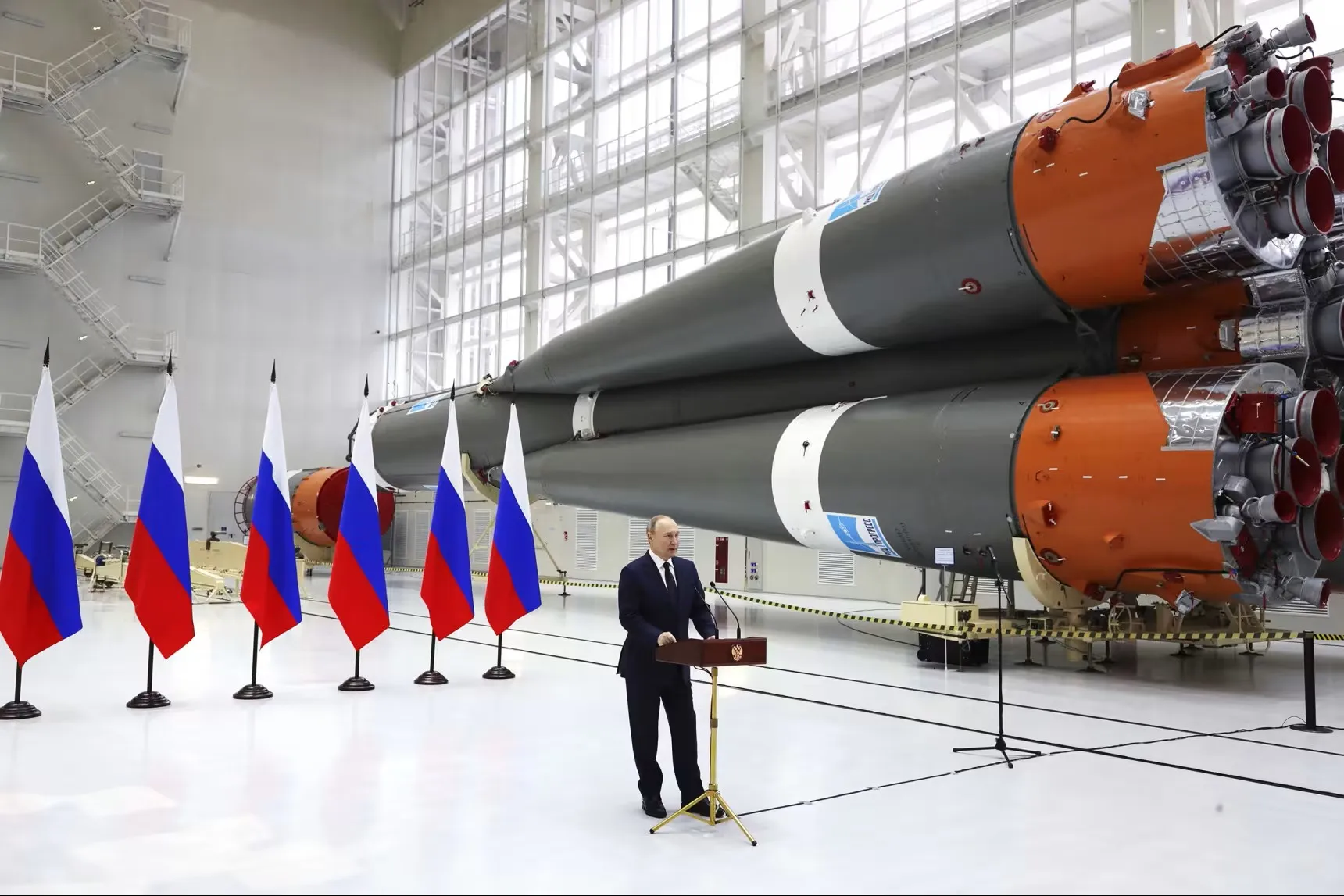
For over three years, Russia wielded the specter of nuclear war as its primary diplomatic weapon in Ukraine. Every battlefield setback and Western arms shipment was met with choreographed warnings about "red lines" and World War III. This strategy succeeded in constraining Biden-era military support. But by late October 2025, Putin's nuclear theater had backfired. It failed to intimidate Trump and exposed the hollowness of Russia's threats.
A Pattern of Nuclear Coercion
Russia's nuclear signaling has followed a predictable pattern since February 2022. When Ukrainian forces launched successful counteroffensives in Kharkiv and Kherson oblasts in fall 2022, the Kremlin's response was immediate and menacing. CIA Director Bill Burns later revealed there was "genuine risk" of Russia using tactical nuclear weapons during this period.[1] Russian officials fabricated claims about Ukraine preparing a "dirty bomb," while Dmitry Medvedev openly threatened nuclear strikes and Ramzan Kadyrov called for using low-yield nuclear weapons.[2]
Each time Western nations considered supplying advanced weaponry, Moscow issued dire warnings.[3] The pattern was clear: battlefield losses triggered nuclear rhetoric designed to deter NATO support and compel Ukraine to accept Russia's terms. The Biden administration, acutely aware of escalation risks, responded with deliberate caution, delivering weapons systems incrementally and with strict limitations on their use.[4] This pattern of incrementalism reflected broader strategic instincts, favoring calibrated support over decisive shifts, yet it also reinforced the Kremlin’s perception that nuclear signaling was an effective constraint on American power.
Act One: The Illusion of Diplomacy
When Trump returned to office, the Kremlin deployed the same playbook, betting that his campaign promises to quickly end the war would make him susceptible to nuclear intimidation. Vice President JD Vance explicitly warned against actions that could trigger World War III, and Trump initially embraced Putin's narrative that Russia's victory was inevitable and American involvement risked catastrophic escalation.[5]
For nine months, Putin successfully strung Trump along with promises of negotiations while continuing his Ukraine offensive. The strategy appeared to work: Trump delayed major weapons deliveries and sanctions with a conviction that restraint would facilitate a peace deal.
Yet, by October 2025, Trump's patience had run out. As it became evident that Putin had no interest in genuine negotiations, only Ukrainian capitulation, Trump imposed his first major sanctions on Russia.[6] It marked a shift in U.S. posture from delayed deterrence to direct economic pressure and signaled that even a transactional administration would not let nuclear blackmail dictate American policy. When Foreign Minister Lavrov reiterated Russia's maximalist demands, Trump abruptly canceled the planned Budapest summit.[7]
Russia's subsequent response revealed both the Kremlin's desperation and the limits of its tactics. Unable to compel Trump through conventional diplomacy, Moscow reverted to its familiar nuclear theater, but with an increasingly absurd twist.
The Wunderwaffe Parade
First came the Burevestnik. In late October, Putin announced the successful test of this nuclear-powered cruise missile, first promised in 2018 but never operationalized.[8] Putin's economic envoy, Kirill Dmitriev, was dispatched to Washington to inform American officials about this "unique weapon that no other country possesses."[9]
The choice of messenger was telling. Dmitriev, head of Russia's Direct Investment Fund, breathlessly described Russia's unstoppable new missile. It was economic diplomacy attempting to do the job of military intimidation — a sign of how threadbare Moscow’s actual leverage had become.
The response from the Trump administration was scathing. Treasury Secretary Scott Bessent openly ridiculed Dmitriev, calling him "a Russian propagandist.”[10] When cabinet officials publicly mock Russian envoys, Moscow is not just losing the argument – it is losing the narrative. Russia's emissaries had become objects of public derision.
Western experts were similarly unimpressed. The Burevestnik is subsonic, making it far less threatening than Russia's existing hypersonic systems.[11] As nuclear analyst Pavel Podvid noted, "the main reason nobody has built this system is that it's not a very effective weapon.”[12]
Trump cut through the theatrics with characteristic bluntness: "They know we have a nuclear submarine, the greatest in the world, right off their shores. So I mean, it doesn't have to go 8,000 miles."[13] He was almost certainly referring to the U.S. Ohio-class submarines operating from Norwegian waters, whose Trident missiles have a flight time to Moscow of approximately ten minutes.[14] Why build an exotic, unreliable cruise missile when America's existing arsenal already checks any Russian move?
The Poseidon Fiasco
When the Burevestnik failed to impress, Putin doubled down. On October 29, he announced the successful test of Poseidon, a nuclear-powered torpedo that allegedly could generate 500-meter radioactive tsunamis to devastate American coastal cities.[15] Russian officials claimed this "doomsday weapon"[16] could render entire nations uninhabitable.
Here, Putin's nuclear theater collapsed entirely. Trump appeared to misinterpret the tests, mistaking nuclear propulsion for nuclear detonation. On October 30, Trump announced he was ordering the Pentagon to immediately resume nuclear testing "on an equal basis" with Russia, something the United States has not done since 1992.[17]
The Kremlin's reaction was swift. Spokesman Dmitry Peskov rushed to clarify that Russia was "not conducting nuclear tests" and that the missiles merely had nuclear-powered engines.[18] Moscow found itself in the absurd position of having to walk back its own intimidation campaign, explaining that its "doomsday weapons" weren't actually evidence of resumed nuclear testing. The attempt at nuclear blackmail had backfired, potentially triggering an arms race that Russia cannot afford.
The Wonder Weapons That Never Were
The Poseidon fiasco fits a broader pattern: Russia's parade of "wonder weapons" consistently fails to live up to its billing. Consider the trajectory of Putin's most-hyped military systems unveiled over the past decade.
Unveiled in 2015, Russia's T-14 Armata tank was billed as a revolutionary leap in armor and automation.[19] The Kremlin promised 2,300 units by 2020. Nearly a decade later, fewer than 20 exist,[20] none deployed in Ukraine. In 2024, Russia admitted the tank was too expensive,preferring cheaper T-90s.[21] Ukrainian intelligence confirms the T-14 has never seen combat.[22]
The RS-28 Sarmat ICBM, dubbed "Satan II," has fared even worse. Unveiled in 2018 as Russia's next-generation intercontinental ballistic missile capable of carrying 16 nuclear warheads, it was supposed to replace aging Soviet-era systems by 2020.[23] On October 29, 2025, Putin himself quietly walked back years of claims, admitting the Sarmat is "not yet deployed,” a stunning reversal for a weapon he had previously declared operational and "invincible."[24]
The Oreshnik missile, Russia's newest showcase weapon used against Ukraine in November 2024, tells a similar story. Putin touted it as an unstoppable hypersonic wonder weapon.[25] The missile's dramatic debut was designed for psychological impact, not military utility; a nuclear weapons expert Pavel Podvig notes its accuracy is suitable for nuclear payloads but not conventional ones, and Russia lacks the inventory to use it regularly.[26]
This pattern reveals a crucial truth: Russia's nuclear blackmail relies heavily on theatrical demonstrations of systems that either don't work, can't be produced at scale, or exist primarily in propaganda. The gap between Putin's boasts and Russia's actual military-industrial capacity has never been wider.
The Kremlin's Script Won't Get Renewed for Another Season
Putin's nuclear coercion failed with Trump for several reasons. First, Trump's transactional worldview is less susceptible to abstract escalation theories that constrained Biden. Where Biden's team engaged in careful escalation management, Trump simply reminded Putin of America's overwhelming strategic advantage and signaled to him to make peace instead of testing missiles.
Second, Trump's unpredictability became an asset rather than a liability. His willingness to announce nuclear weapons testing, even if based on a misunderstanding, demonstrated that he would not be paralyzed by fear of escalation. Putin's calculation that Trump could be intimidated through nuclear signaling proved wrong.
Third, the very absurdity of Russia's latest "wonder weapons" and the scramble to walk back their threats revealed their emptiness. This was not the behavior of a confident nuclear power. It was desperation masked as strength.
Taken together, this pattern points to a deeper strategic problem—not Russian capabilities, but how deterrence itself has been interpreted and applied. This raises an uncomfortable question for those who crafted Biden-era escalation management: Did the policy of restraint validate Russian coercion by demonstrating that nuclear threats could meaningfully shape American behavior?
Trump’s recklessness may have been strategically effective precisely because it disrupted a dynamic in which measured responses had become predictable constraints. The lesson is not to embrace chaos, but to recognize that deterrence sometimes requires credible unpredictability. When predictability becomes a liability, uncertainty can act to stabilize.
The Strategic Implications
The failure of Putin's nuclear blackmail with Trump represents a potential inflection point in the war. For three years, the threat of escalation shaped Western policy, leading to delayed weapons deliveries and self-imposed restrictions on Ukrainian operations. Biden's caution, while prudent given the stakes, may have inadvertently validated Putin's strategy by demonstrating that nuclear threats could constrain Western support. The Trump-era shift suggests that unpredictability, if properly bound, may serve as a deterrent in its own right.
Chaotic and potentially dangerous though it is, Trump's approach has called Putin's bluff. By responding to Russian nuclear theater with reminders of American military superiority rather than restraint, Trump has made clear that the old playbook no longer works. Putin cannot intimidate his way to victory in Ukraine, cannot compel Western powers to abandon Kyiv through threats, and cannot string along a U.S. president with hollow negotiations and maximalist demands.
That shift has not been confined to Washington. The erosion of Russia’s nuclear credibility has loosened Europe’s own psychological constraints. For much of the war, fear of nuclear escalation served as the strongest argument for limiting support to Ukraine, particularly among more cautious political factions. As Moscow’s threats grow increasingly performative, that restraint has become harder to justify. In undermining its own coercive leverage, the Kremlin has inadvertently reinforced the very order it sought to fracture.
This doesn't eliminate nuclear risks; far from it. A cornered Russia remains dangerous, and the casual discussion of resumed nuclear testing is alarming. But it does suggest that Putin's primary lever for compelling Western concessions has broken. Russia must now confront an uncomfortable reality: its conventional military has failed to defeat Ukraine, its economy groans under sanctions, and its nuclear threats no longer paralyze its adversaries.
From Nuclear Signaling to Hybrid War
One consequence of this strategic dead end is how Moscow is likely to adapt. Deprived of its most theatrical deterrent, Russia is likely to lean further into its arsenal of hybrid warfare tools. Cyberattacks, sabotage operations, and deniable drone activity may intensify across NATO’s eastern flank. Recent airspace violations over Poland, Romania, and Estonia, along with unexplained drone sightings as far west as Germany and Denmark, illustrate a strategy that prioritizes ambiguity over escalation.[27]
Hybrid warfare offers Putin a safer form of coercion: disruptive enough to signal defiance, but unlikely to provoke catastrophic retaliation. Yet this shift also signals weakness. When nuclear threats lose credibility, deniable provocations become a substitute—not as a sign of strength, but of constrained options.
Epilogue: The End of the Nuclear Theater
The October 2025 Poseidon episode will likely be remembered as the moment Putin's nuclear blackmail reached its expiration date. When nuclear intimidation requires officials to clarify that no nuclear tests have occurred, the strategy has already failed. When economic envoys must promote military capabilities in place of credible military leadership, the bluff is exposed. When a parade of wonder weapons reveals the gap between propaganda and reality, the theater collapses.
The question now is whether Putin can adapt to this new reality. His nuclear arsenal remains real and dangerous, but its utility as a tool of coercion has diminished. For years, it served not just as a military deterrent but as a psychological trap, one that kept U.S. policymakers second-guessing their own moves. But that spell has broken. For over three years, European governments calibrated their red lines around Washington's nuclear caution. A firmer U.S. stance now gives NATO space to rethink how it responds to Russian signaling.
This moment invites a reassessment of U.S. nuclear risk posture, especially the reflexive caution that has governed policy since 2022. Rather than treating every Russian threat as a veto on policy, Washington can begin to distinguish between credible signals and empty coercion—and respond accordingly.
Igor Desyatnikov has spent over two decades as a portfolio manager and macro strategist at leading global financial institutions. He is a graduate student in Government at Harvard, focusing on international security and the post-Soviet space. His work has appeared in The Hill and Geopolitical Monitor.
[1] Holly Ellyatt, “CIA Director Says There Was a ‘Genuine Risk’ Russia Could Use Nuclear Weapons in Ukraine,” CNBC, September 7, 2024, https://www.cnbc.com/2024/09/07/cia-director-russia-ukraine-war-nuclear-weapon-risk.html.
[2] "Russia Can Defend New Regions with Nuclear Weapons, Medvedev Says," Al Jazeera, September 22, 2022, https://www.aljazeera.com/news/2022/9/22/russia-can-defend-new-regions-with-nuclear-weapons-medvedev-says,
"Kadyrov Calls on Russia to Use Low-Yield Nuclear Weapon in Ukraine," Jerusalem Post, October 2, 2022, https://www.jpost.com/breaking-news/article-718676.
[3] Greg Myre, “Russia Warns the U.S. Not to Send More Military Aid to Ukraine,” NPR, April 29, 2022, https://www.npr.org/2022/04/29/1095458518/russia-ukraine-us-military-aid.
[4] Ilan Berman, “Joe Biden’s ATACMS Decision Is Too Little, Too Late,” American Foreign Policy Council, October 2023, https://www.afpc.org/publications/articles/joe-bidens-atacms-decision-is-too-little-too-late.
[5] Carol E. Lee, "Vance Leans Hard Into Trump's Foreign Policy, Sparks Extraordinary Oval Office Meeting," NBC News, January 25, 2025, https://www.nbcnews.com/politics/trump-administration/vance-leans-hard-trumps-foreign-policy-sparks-extraordinary-oval-offic-rcna194256.
[6] David E. Sanger, “Trump Imposes Sanctions on Russia Over Ukraine War,” New York Times, October 22, 2025, https://www.nytimes.com/2025/10/22/us/politics/trump-sanctions-russia-ukraine.html.
[7] “Trump-Putin Summit Cancelled After Moscow Sent Memo to Washington, FT Reports,” Reuters, October 31, 2025, https://www.reuters.com/world/europe/trump-putin-summit-cancelled-after-moscow-sent-memo-washington-ft-reports-2025-10-31/
[8] “Putin Says Russia Successfully Tested Nuclear-Powered Cruise Missile,” Reuters, October 27, 2025, https://www.reuters.com/world/europe/putin-says-russia-tested-nuclear-powered-cruise-missile-2025-10-27/.
[9]Patrycja Bazylczyk and Hannah Freeman, “Russia’s Nuclear-Powered Burevestnik Missile: Implications for Missile Defense,” Center for Strategic and International Studies, November 7, 2025, https://www.csis.org/analysis/russias-nuclear-powered-burevestnik-missile-implications-missile-defense
[10] "Putin Panics: Kremlin Henchman's PR Tour Backfires as Trump's Oil Sanctions Bite," New York Post, October 27, 2025, https://nypost.com/2025/10/27/world-news/putin-panics-kremlin-henchmans-pr-tour-backfires-as-trumps-oil-sanctions-bite/.
[11] Jeffrey Lewis, "Russia's Burevestnik Nuclear-Powered Missile Is a Very Bad Idea," Scientific American, October 27, 2025, https://www.scientificamerican.com/article/russias-burevestnik-nuclear-powered-missile-is-a-very-bad-idea/
[12] "What We Know About Russia's Latest Test of the Nuclear-Powered Burevestnik Missile," Moscow Times, October 27, 2025, https://www.themoscowtimes.com/2025/10/27/what-we-know-about-russias-latest-test-of-the-nuclear-powered-burevestnik-missile-a90939
[13] "Trump Says Putin Should End Ukraine War, Not Test Missiles," Reuters, October 27, 2025, https://www.reuters.com/business/aerospace-defense/trump-says-putin-should-end-ukraine-war-not-test-missiles-2025-10-27/
[14] Peter Vincent Pry, “Black Brant XII,” in War Scare: Russia and America on the Nuclear Brink (New York: Praeger, 1999), 214–27.
[15] Robert Farley, "Fact or Fiction: Iran Could Use a 'Nuclear Tsunami' to Destroy Israel," National Interest, January 20, 2021, https://nationalinterest.org/blog/reboot/fact-fiction-iran-could-use-nuclear-tsunami-destroy-israel-181333
[16] “Putin Unveils Nuclear Submarine Capable of Creating Radioactive Waves,” LBC, January 2018, https://www.lbc.co.uk/article/putin-nuclear-submarine-radioactive-waves-5HjdGJC_2/.
[17] Oren Liebermann, "Trump Orders Pentagon to Resume Nuclear Weapons Testing," CNN, October 30, 2025, https://www.cnn.com/2025/10/30/politics/us-nuclear-testing-trump-advisers.
[18] "Kremlin Says Russia Not Conducting Nuclear Weapons Tests," TASS, October 30, 2025, https://tass.com/politics/2037465.
[19] Maya Carlin, “Russia’s T-14 Armata: From Most Advanced Tank on Earth to Failure,” 19FortyFive, December 2025, https://www.19fortyfive.com/2025/12/russias-t-14-armata-from-most-advanced-tank-on-earth-to-failure/.
[20] Maya Carlin, “Russia’s Troubled T-14 Main Battle Tank Has a Message for the U.S. Army,” 19FortyFive, February 2026, https://www.19fortyfive.com/2026/02/russias-troubled-t-14-main-battle-tank-has-a-message-for-the-u-s-army/
[21] Jake Epstein, "Russia Is Unlikely to Use Its Best Tank in Ukraine Because It's Too Costly, Weapons Maker Says," Business Insider, March 1, 2024, https://www.businessinsider.com/russia-unlikely-using-best-tank-ukraine-too-costly-weapons-maker-2024-3.
[22] “Ukrainian Intelligence Unveils Details on Russian Armata Tank Production,” Defence Blog, January 26, 2024, https://defence-blog.com/ukrainian-intelligence-unveils-details-on-russian-armata-tank-production/.
[23] “RS-28 Sarmat / Satan II,” GlobalSecurity.org, accessed March 9, 2026, https://www.globalsecurity.org/wmd/world/russia/rs-28-program.htm.
[24] "Humbling Setback for Vladimir Putin as Satan 2 Nuclear Missile Still Not Deployed," MSN (via Daily Express), October 29, 2025, https://www.msn.com/en-us/news/world/humbling-setback-for-vladimir-putin-as-satan-2-nuclear-missile-still-not-deployed/ar-AA1Puh3g.
[25] Tom Balmforth and Mariano Zafra, “Inside Russia’s New Missile, ‘Oreshnik,’” Reuters, November 28, 2024, last updated January 9, 2026, https://www.reuters.com/graphics/UKRAINE-CRISIS/RUSSIA-MISSILE/gdpzknajgvw/.
[26] “Ukraine War Briefing: Oreshnik Missile Sparks Anger at UN Security Council,” The Guardian, January 13, 2026, https://www.theguardian.com/world/2026/jan/13/ukraine-war-briefing-oreshnik-missile-sparks-anger-at-un-security-council.
[27] Reuters, “Russia’s Suspected ‘Hybrid War’ Puts European Air Defences to the Test,” November 5, 2025, https://www.reuters.com/business/aerospace-defense/russias-suspected-hybrid-war-puts-european-air-defences-test-2025-11-05/