
Correlated Risk at Allied Seaports: The Case for a Common Cyber Baseline
Allied seaports share crane and software suppliers but follow divergent national cyber rules, creating correlated risk that no single port can manage. Allies need a common security baseline for their strategic ports.
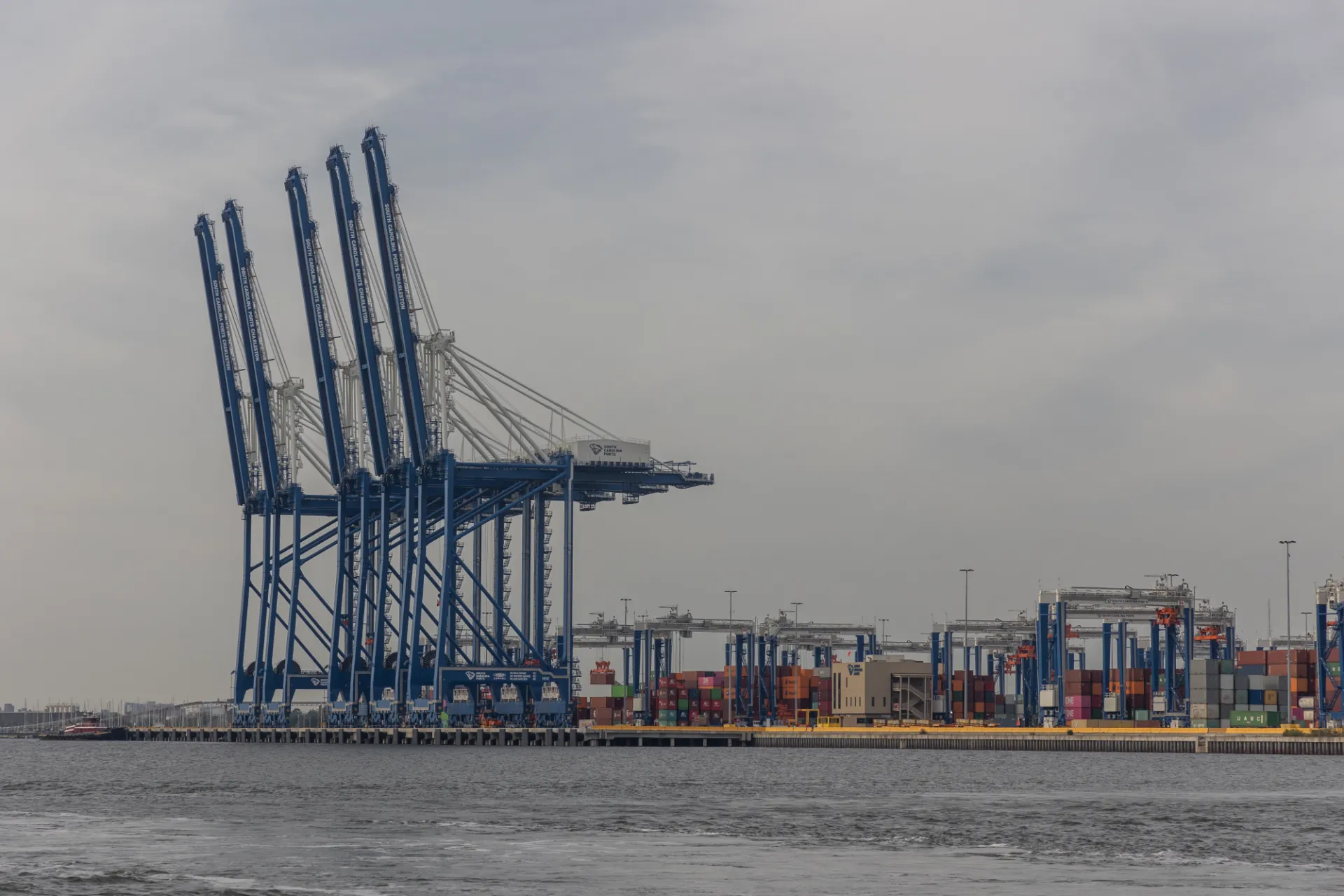
In March 2026, a ransomware attack hit the cargo management servers of Spain’s Port of Vigo, forcing the port authority to isolate the affected systems and move some operations to manual procedures.[1] In August 2026, an outside intrusion into the information technology (IT) systems of the North Carolina State Ports Authority affected all three of its locations and left operations to be processed manually.[2] In September, a cybersecurity incident at Malaysia’s Port of Tanjung Pelepas suspended terminal operations until a phased restart began on September 10.[3]
These events are usually treated as isolated, facility-level failures. That treatment is mistaken. Allied seaports share equipment suppliers, software platforms, and shipping networks, so their cyber risk is correlated, not independent. National and facility-level controls are necessary but not sufficient; the problem is one of coordination among allies.
Terminals Are Cyber-Physical Systems
A container terminal is a cyber-physical system in which IT and operational technology (OT) are tightly coupled. Terminal operating systems schedule berths, yards, and container moves; gate systems verify trucks and documents; and ship-to-shore cranes run on programmable logic controllers and supervisory software, increasingly networked for remote diagnostics and vendor maintenance.
This convergence widens the risk of attack in three ways. Ransomware against enterprise IT can stop physical throughput even when OT is untouched. Remote maintenance pathways can bypass the port’s own perimeter. OT components have long service lives and narrow patching windows, so known vulnerabilities persist for years.
Typical OT components remain in service for 10 to 15 years, sometimes longer, and many run older operating systems that their vendors no longer support with patches. Updates must be tested by both the vendor and the operator before installation, and the outages needed to apply them must often be scheduled days or weeks in advance. Where a legacy system cannot be patched, National Institute of Standards and Technology (NIST) advises compensating controls instead.[4]
Shared systems also concentrate failure. In July 2023, a ransomware infection caused the failure of the Nagoya Port Unified Terminal System, the central system controlling all container terminals at Japan’s largest port, which handles about 10% of the country’s trade, and container loading and unloading at its terminals were canceled.[5]
The stakes are large. The U.S. Marine Transportation System supports nearly 95% of cargo entering the United States and about $5.4 trillion in annual economic activity.[6] Ports handle 74% of the European Union’s (EU) external trade.[7] In November 2023, an incident at DP World Australia, which handles almost 40% of goods moving in and out of the country, halted terminals in Melbourne, Sydney, Brisbane, and Fremantle and left about 30,000 containers stranded.[8]
One Supplier, Many Ports
The central risk is supplier concentration. A joint investigation by the House Committee on Homeland Security and the Select Committee on the Chinese Communist Party, released in September 2024, found that Shanghai Zhenhua Heavy Industries (ZPMC) accounts for nearly 80% of ship-to-shore cranes at U.S. ports, and that ZPMC or a contractor had installed cellular modems on cranes at certain ports outside the scope of any contract.[9]
ZPMC had also repeatedly requested remote access to its cranes, and the contracts reviewed contained no provisions barring unauthorized modifications.[10]
An undocumented, out-of-band channel defeats network segmentation, because it is invisible to the facility’s monitoring. When one manufacturer equips ports across North America, Europe, and Asia, a latent hardware or firmware weakness becomes a common-mode vulnerability: one defect, replicated across many allied facilities. Terminal software is similarly concentrated among a few vendors.
Interconnected software systems demonstrate how a single cybersecurity breach can rapidly spread across port operations. In 2017, NotPetya spread from a backdoored Ukrainian accounting program into the networks of A.P. Moller-Maersk, which halted operations at 76 port terminals around the world. Maersk reinstalled 4,000 servers and 45,000 PCs and ran on manual processes for about ten days, at a cost it put at $200 million to $300 million.[11]
The pattern is already visible. On October 12, 2026, the extortion group n0n listed 38 organizations across 18 countries, nearly all in shipping, ports, and logistics, on its leak site in a single batch. The claims remain unverified, but SOCRadar assessed that the listings likely point to a single exposed application or vulnerability rather than 38 separate intrusions. ZPMC itself was among those named, and one maritime cybersecurity firm pointed to a possible compromise of a shared environment at a maritime software provider.[12]
Washington acted in February 2024, expanding Coast Guard authority over maritime cyber incidents, announcing a Maritime Security Directive on Chinese-manufactured ship-to-shore cranes, and highlighting plans by PACECO, a U.S. subsidiary of Japan’s Mitsui E&S, to bring crane manufacturing back to the United States.[13] These measures protect U.S. facilities, but they do nothing for the same equipment in allied ports that move U.S. and allied cargo.
Foreign Ownership Widens the Exposure
Foreign ownership compounds the problem. In May 2023, Germany approved a stake of just under 25% for COSCO Shipping Ports, a unit of the Chinese state-owned shipping group COSCO, in Hamburg’s Tollerort terminal, after designating the terminal critical infrastructure.[14] COSCO had originally sought 35%, and it already held stakes in terminals at Rotterdam and Antwerp and a controlling stake in Piraeus.[15]
Although minority ownership does not necessarily confer operational control, it may provide access to sensitive data and create opportunities for system integration. However, national screening reviews typically assess foreign investments individually, potentially overlooking the cumulative risks of ownership across multiple ports. The EU’s pledge to develop criteria on foreign ownership of strategic ports acknowledges the gap without yet closing it.[16]
Ports Are the Front Door of Allied Military Mobility
The risk extends beyond trade. A cyber incident that forces a strategic port onto manual processing can slow military cargo as well as commercial cargo, and in a crisis that could disrupt military deployment timelines. The U.S. Strategic Seaport Program comprises 18 commercial and 6 military ports, and the Maritime Administration, with U.S. Transportation Command and other agencies, monitors the commercial ports’ readiness through the National Port Readiness Network.[17] A September 2026 Foundation for Defense of Democracies study urged the alliance to direct defense investment toward the physical and cyber resilience of the assets military mobility depends on.[18]
Yet the monitoring standard for these ports lags behind the one the Navy is setting for its own ships. Naval Sea Systems Command is deploying SABER (Situational Awareness, Boundary Enforcement, and Response), developed with the Johns Hopkins University Applied Physics Laboratory, which continuously and autonomously monitors shipboard hull, mechanical, and electrical systems, as well as navigation and combat systems for signs of cyberattack.[19]
By contrast, the Coast Guard’s 2025 rule for commercial ports requires multifactor authentication for remotely accessible OT, hardware and software inventories, logging, and network segmentation, but not continuous OT monitoring.[20] A strategic port can therefore be the least monitored link in a military deployment.
A Fragmented Regulatory Map
Because the risk is correlated, a gap in one jurisdiction becomes exposure for the others. Yet allied ports answer to separate regimes that differ in what they require and when they take effect.
The U.S. Coast Guard rule, in force since July 16, 2025, requires cyber incidents to be reported without delay, and, by July 16, 2027, a designated Cybersecurity Officer, a cybersecurity assessment, and an approved Cybersecurity Plan.[21]
The EU Ports Strategy, adopted in March 2026, commits the Commission to a forum for national cybersecurity and port authorities, an EU-wide security risk assessment, and criteria on foreign ownership.[22] These steps are meaningful but largely consultative; they set no port-level technical requirements and do not address cranes.
At the multilateral level, the International Maritime Organization’s Guidelines on Maritime Cyber Risk Management, last revised in May 2026, are recommendatory and written primarily for ships.[23]
The result is a patchwork. A U.S. terminal must hold an approved cybersecurity plan by July 2027; a European terminal faces differing national rules; a partner-country port outside both may face almost none. Because these ports exchange vessels, cargo data, and suppliers, the system is only as secure as its least protected node.
A Common Baseline Without a Common Regulator
The answer is not a supranational port regulator, which is neither feasible nor necessary, but a common baseline that keeps a weakness in one jurisdiction from undermining another. Four measures follow.
First, a common allied baseline for strategic ports. The United States, the EU, and partners including the United Kingdom, Canada, Japan, and Australia should set minimum requirements for designated strategic ports: incident reporting within hours, a cybersecurity officer, periodic risk assessment, and an approved response plan, with technical controls mapped to the NIST Cybersecurity Framework 2.0 and the IEC 62443 standards for industrial control systems.[24] Each government would certify its own ports against the baseline, and allies would accept one another’s certifications.
Second, joint assurance of critical equipment. Allies should coordinate technical reviews of cranes, gate systems, and terminal software and share findings through government channels. Procurement should require hardware and software bills of materials, so that undocumented components such as out-of-band modems are caught by design rather than by investigation. Bills of materials show where ports depend on a single supplier, but visibility alone does not reduce that dependence. Allies should also co-finance trusted alternatives, building on efforts such as PACECO’s plan to manufacture cranes in the United States, so that ports replacing equipment can choose among more suppliers.
Third, allied incident information sharing. U.S. mandatory reporting and the EU’s planned forum should be linked through a structured channel for sharing indicators of compromise among allied port authorities. When vulnerabilities are common-mode, a warning from the first victim protects the rest. Had a shared entry point been confirmed at one organization named by n0n, the others could have been warned before their names were published.
Finally, degraded-mode operating requirements. Vigo, North Carolina, and Tanjung Pelepas kept or restored throughput through manual fallback and phased recovery. Strategic ports should maintain and exercise documented procedures for operating without primary IT systems for a defined period. Resilience, not prevention alone, should be an explicit regulatory goal.
Objections
Three objections deserve an answer. The first is sovereignty. A common baseline leaves enforcement with national authorities; it supplies a shared standard, not a shared inspectorate, a model allies already accept in aviation security and vessel safety.
The second is cost, which falls hardest on smaller ports. The baseline should apply first to designated strategic ports, where the stakes justify the expense, and its cost should be weighed against disruptions like the one that stranded 30,000 containers across DP World Australia’s terminals in 2023.
The third is supplier politics. Beijing may read joint assurance as coordinated exclusion, and replacing installed cranes is slow and costly. The measures do not require immediate removal. They require visibility into what is installed, contractual control over remote access, and a shared view of what to replace first: a defensible standard for any critical infrastructure, whatever the supplier’s origin.
Securing the System, Not Only the Port
Seaport security was long conceived in physical terms. The convergence of IT and OT, concentrated supply chains, and cross-border ownership have moved much of that risk into the cyber domain, where it requires coordination across borders. Allies have begun to respond, but on separate tracks. A common baseline, joint equipment assurance, shared incident intelligence, and degraded-mode capability would enable the United States and its allies to mitigate the systemic threat.
Laxmi Narayan Behera, based in Philadelphia, PA, is the CEO of LNB Federal Corporation, a U.S. Government contractor providing IT and Cybersecurity services, and an M.S. student in Business Intelligence at the University of Maine at Presque Isle.
______________________________________________________________________________
[1]Daryna Antoniuk, “Ransomware Attack Disrupts Operation at Major Spanish Fishing Port,” The Record, March 25, 2026, https://therecord.media/port-of-vigo-ransomware.
[2]Jonathan Greig, “Cyberattack on North Carolina Ports ‘Contained’ as Coast Guard, State Officials Investigate,” The Record, August 6, 2026, https://therecord.media/cyberattack-north-carolina-ports.
[3]Linton Nightingale, “Cyber Attack Disrupts Operations at Malaysia’s Port of Tanjung Pelepas,” Lloyd’s List, September 2026, https://www.lloydslist.com/LL1158420/Cyber-attack-disrupts-operations-at-Malaysia%E2%80%99s-Port-of-Tanjung-Pelepas; “Cyber Attack Disrupts Operations at Malaysia’s Port of Tanjung Pelepas,” OODA Loop, September 11, 2026, https://oodaloop.com/briefs/cyber/cyber-attack-disrupts-operations-at-malaysias-port-of-tanjung-pelepas/.
[4]Keith Stouffer et al., Guide to Operational Technology (OT) Security, NIST SP 800-82r3 (Gaithersburg, MD: NIST, September 2023), 29–31, 37, https://doi.org/10.6028/NIST.SP.800-82r3.
[5]Bill Toulas, “Japan’s Largest Port Stops Operations After Ransomware Attack,” BleepingComputer, July 5, 2023, https://www.bleepingcomputer.com/news/security/japans-largest-port-stops-operations-after-ransomware-attack/.
[6]“Fact Sheet: Biden-Harris Administration Announces Initiative to Bolster Cybersecurity of U.S. Ports,” February 21, 2024, https://www.presidency.ucsb.edu/documents/fact-sheet-biden-harris-administration-announces-initiative-bolster-cybersecurity-us-ports.
[7]Directorate-General for Mobility and Transport, “Commission Unveils EU Ports Strategy to Strengthen Competitiveness, Security and Sustainability of European Ports,” European Commission, March 4, 2026, https://transport.ec.europa.eu/news-events/news/commission-unveils-eu-ports-strategy-strengthen-competitiveness-security-and-sustainability-european-2026-03-04_en.
[8]“Australia Cyberattack Leaves 30,000 Containers Stuck at Ports,” Bloomberg, via gCaptain, November 13, 2023, https://gcaptain.com/australia-cyberattack-leaves-30000-containers-stuck-at-ports/.
[9]House Committee on Homeland Security, “Investigation by House Homeland, Select Committee on the CCP Finds Potential Chinese Threats to U.S. Port Infrastructure Security,” September 12, 2024, https://homeland.house.gov/?p=5779.
[10]“House Committee: Chinese Cranes Could Be a ‘Trojan Horse’ in U.S. Ports,” The Maritime Executive, September 12, 2024, https://maritime-executive.com/article/house-committee-chinese-cranes-could-be-a-trojan-horse-in-u-s-ports.
[11]Mathew J. Schwartz, “NotPetya Patient Zero: Ukrainian Accounting Software Vendor,” Bank Info Security, July 4, 2017, https://www.bankinfosecurity.com/notpetya-patient-zero-ukrainian-accounting-software-vendor-a-10080; Iain Thomson, “NotPetya Ransomware Attack Cost Us $300m – Shipping Giant Maersk,” The Register, August 16, 2017, https://www.theregister.com/2017/08/16/notpetya_ransomware_attack_cost_us_300m_says_shipping_giant_maersk/; Ry Crozier, “Maersk Had to Reinstall All IT Systems After NotPetya Infection,” iTnews, January 25, 2018, https://www.itnews.com.au/news/maersk-had-to-reinstall-all-it-systems-after-notpetya-infection-481815.
[12]Omer Faruk Diken, “n0n Group Puts Dozens of Global Ports and Shipping on Its Leak Site,” SOCRadar, October 13, 2026, https://socradar.io/blog/n0n-group-global-ports-shipping-leak/; “Massive Cyber Attack Threatens Release of Data from 38 Maritime Companies,” The Maritime Executive, October 14, 2026, https://maritime-executive.com/article/massive-cyber-attack-threatens-release-of-data-from-38-maritime-companies.
[13]“Fact Sheet: Biden-Harris Administration Announces Initiative.”
[14]“Germany Approves COSCO Stake in Hamburg Port Terminal,” Reuters, via gCaptain, May 10, 2023, https://gcaptain.com/germany-approves-cosco-stake-in-hamburg-port-terminal/.
[15]“German Government to Allow China COSCO to Buy a 24.9% Stake in a Hamburg Container Terminal,” PortNews, October 26, 2022, https://en.portnews.ru/news/337599.
[16]Directorate-General for Mobility and Transport, “Commission Unveils EU Ports Strategy.”
[17]Bruce Busler, “The Fight to Get to the Fight: Deploying from a Contested Homeland,” Defense Transportation Journal, National Defense Transportation Association, October 3, 2024, https://www.ndtahq.com/the-fight-to-get-to-the-fight-deploying-from-a-contested-homeland/.
[18]Foundation for Defense of Democracies, Strengthening NATO Through Military Mobility and Critical Infrastructure Cybersecurity (Washington, DC: Foundation for Defense of Democracies, September 28, 2026), https://www.fdd.org/analysis/2026/09/28/strengthening-nato-through-military-mobility-and-critical-infrastructure-cybersecurity/.
[19]“Johns Hopkins APL Contributions Fuel Critical Navy Cybersecurity System,” Johns Hopkins University Applied Physics Laboratory, April 21, 2026, https://www.jhuapl.edu/news/news-releases/260421-navy-saber.
[20]U.S. Coast Guard, “Cybersecurity in the Marine Transportation System,” final rule, Federal Register 90, no. 11 (January 17, 2025): 6298, https://www.federalregister.gov/documents/2025/01/17/2025-00708/cybersecurity-in-the-marine-transportation-system.
[21]“Final Rule: Cybersecurity in the Marine Transportation System, Implementation Timeline,” Maritime Commons, U.S. Coast Guard, July 16, 2025, https://www.news.uscg.mil/maritime-commons/Article/4247529/final-rule-cybersecurity-in-the-marine-transportation-system-implementation-tim/.
[22]Directorate-General for Mobility and Transport, “Commission Unveils EU Ports Strategy.”
[23]International Maritime Organization, Guidelines on Maritime Cyber Risk Management, MSC-FAL.1/Circ.3/Rev.4 (London: International Maritime Organization, May 28, 2026), https://wwwcdn.imo.org/localresources/en/OurWork/Facilitation/FAL%20related%20nonmandatory%20documents/MSC-FAL.1-Circ.3-Rev.4.pdf.
[24]National Institute of Standards and Technology, The NIST Cybersecurity Framework (CSF) 2.0, NIST CSWP 29 (Gaithersburg, MD: National Institute of Standards and Technology, February 26, 2024), https://doi.org/10.6028/NIST.CSWP.29; International Electrotechnical Commission, IEC 62443: Security for Industrial Automation and Control Systems (Geneva: International Electrotechnical Commission, n.d.).