Trafficking in persons represents a serious crime, although one that is not yet fully explored. Notwithstanding, what is known about it makes one wonder how this modern-day slavery could acquire such immense proportions. The international community has progressed a long way over the past two decades in understanding and tackling the crime of human trafficking. Throughout the 1990s, it was primarily viewed as, and often confused with, illegal migration. The UN Convention against Transnational Organized Crime with its Protocols adopted in 2000 successfully addressed this distinction and inaugurated…
With the advent of online banking, financial crime has moved from the physical world to the virtual. Today’s villains carry out identity theft, credit card fraud, and siphoning schemes from the comfort of their computer chairs. The evolution of financial crime to the online platform has shifted the financial activities of transnational organized crime networks, which now take full advantage of the system to perform illicit internet transfers, hide funds, and engage in fraudulent schemes. Some law enforcement officials are uncovering new transnational organized crime networks, whose activities…
On election night, California voters passed Proposition 35, which increases penalties for those convicted of human trafficking. California is among the top four destinations for human trafficking in the United States. According to a recent study by California’s Attorney General, 1,277 people have been identified as victims of human trafficking and forced labor in the last two years in California.
Globally, the $32 billion-per-year human trafficking industry is estimated to affect 2.4 million people. This April, the Director of the United Nations Office on Drug and Crime asked…
It has become a truism to describe transnational problems as interconnected. However, a recent joint report “Green Carbon, Black Trade: Illegal Logging, Tax Fraud and Laundering in the World’s Tropical Forests”by the United Nations Environment Programme (UNEP) and INTERPOL shows that illegal logging is a case that truly demonstrates the need for cooperation across sectors to reach efficient solutions. No single solution will be enough; action will be needed at each stage of the supply and demand chain at both local and international levels. Many of the proposed solutions have major shortcomings…
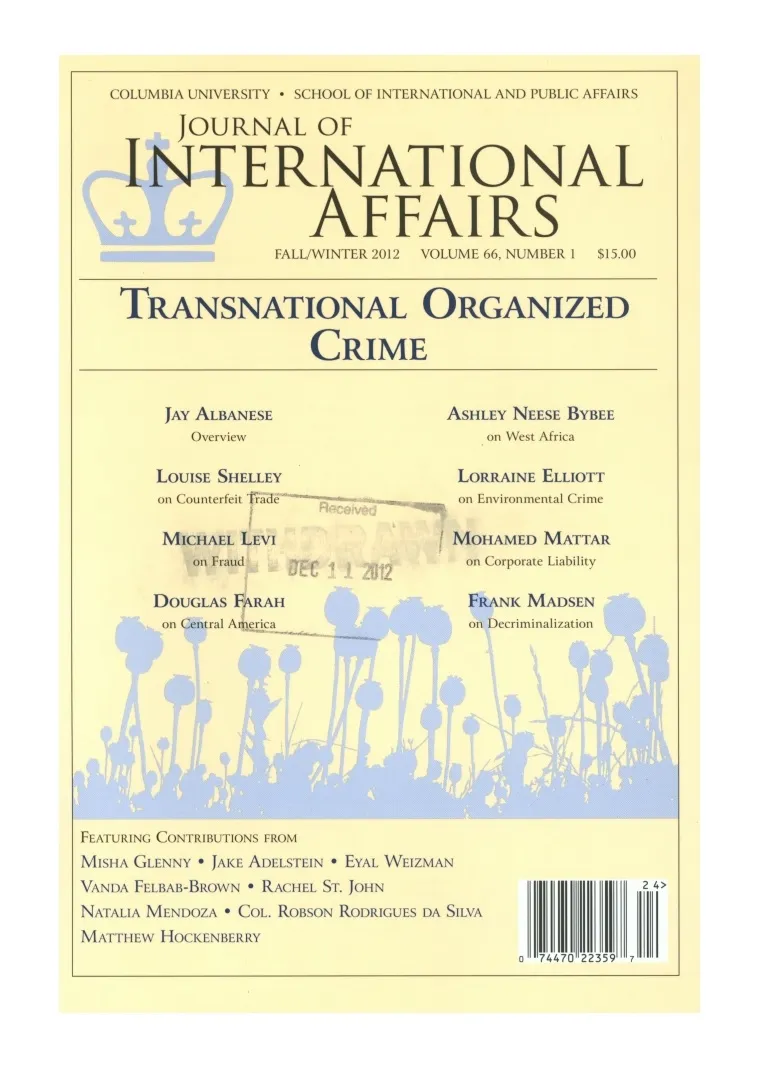
Vanda Felbab-Brown, an expert on illicit economies and international and internal conflict management, analyzes the unprecedented pace at which the illicit drug trade is expanding. Her perspective identifies common mistakes in antidrug-designed policies and stresses the need for governments to reprioritize their objectives. She debunks established myths around the commonality of drug trade and its impact on society. Often, policies are not successful because public officials do not effectively identify the central issues surrounding drug violence or the consequences of implementing antidrug trade…