
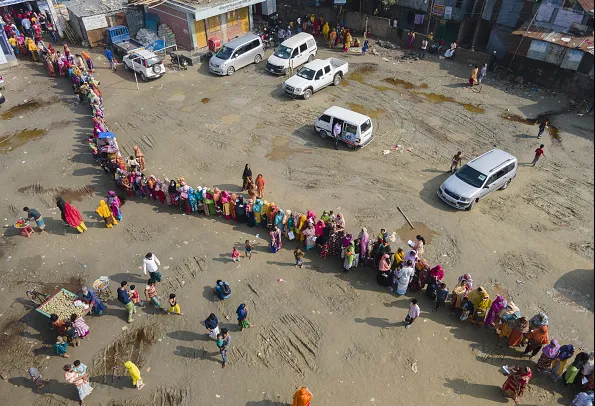
In the 20th century, the urban-rural divide drove urbanization in much of the world by encouraging migration from rural to urban areas. There were always marked regional variations in the outcomes of this process as net migration rates to cities waxed and waned in response to shifts in the costs and benefits of urban-based livelihoods. Newer factors affecting incomes and the costs of urban living have also arisen and influenced the nature of the divide. These include shifts in the global geography of different types of urban-based employment and significant rises in the costs of urban housing,…
Africa was once expected to be the heartland of COVID-19 cases and deaths—a monumental disaster waiting to happen. Yet, while Africa accounts for 17.2 percent of the world population, it thus far accounts for only 4 percent of COVID-19 deaths and 2.7 percent of cases globally. What does this appreciable disparity reveal or occlude about the management of public health emergencies in African cities? This essay explores lessons learned from addressing the COVID-19 pandemic in urban Africa, ranging from early and aggressive responses to community-led initiatives and sound public health policies…
The past two decades saw the expansion of what we could call “global urban governance,” with urban issues sprawling across several multilateral sectors, as well as the thriving of “city diplomacy,” meaning the international relations of local authorities. Many actors in world politics embraced this expanded role for cities, but what about nation-states? With the continued influence of inward-looking nationalism and the enduring clout of many national governments on both domestic and international fronts, tensions between central and local executives might have surged to an all-time…
At the Africities Summit 2018, African city representatives discussed the role of local authorities in the UN Global Compacts for Migration and Refugees and adopted the Charter of Local and Subnational Governments of Africa on Migration. At first glance, this municipal engagement may seem surprising, given that most African cities lack mandates for action on migration at the local, let alone the international level. However, in practice, a growing number of migrants and refugees are settling in African cities, whose local authorities are therefore confronted with core issues of international…

Abstract
Predatory governments in the Middle East have survived despite widespread popular revolt and epic governance failures. Only a new governing compact can end this destructive but sustainable cycle. Using the examples of Lebanon and Iraq, we show how hybrid reform efforts that recognize the weakness of the state can renew approaches to citizenship, stability, and security.
Abstract
From collective flash-mobs such as “clap for our carers,” to solidarity campaigns launched by a variety of activist organizations, to the Black Lives Matter movement and anti-lockdown protests by right-wing groups, the COVID-19 crisis has been marked by intense social protest. In this article, I analyze these protests as different responses to the exceptional conjuncture of the pandemic, through the lens of social movement theory and the analysis of grievances and action repertoires. Focusing on the United States and Europe, I highlight that protests during the pandemic…
Abstract
In the decade following independence, India, Pakistan, and Sri Lanka all saw ethnic protests as a result of nationalist language policies. The outcomes of these protests varied from peaceful co-optation by the state to civil war. What explains this? Research on ethnic unrest in the region has focused on structural factors, using identity cleavages, social networks, and ethnic fractionalization to explain how an ethnic group may behave during periods of unrest. In contrast, this paper examines three cases of ethnic protests in the context of state response. Tracing the process of the…
Abstract
This paper examines the rise of conflicts over the extraction of natural resources in the developing world. It emphasizes the main factors that motivate collective action: threats and opportunities. Challengers join in action to avoid the adverse socio-environmental effects associated with extraction, but they also mobilize because of new opportunities or advantages that extraction brings to host communities. These incentives are most likely to trigger collective action at the local level but can also prompt the participation of outside groups, depending…
Abstract
Hong Kong’s 2019–20 Water Movement has two distinctive features, expressed in Cantonese as “no main stage” (leaderless) and “no mat-cutting” (do not split). Drawing on original sources and firsthand experience on the ground, this paper reviews the campus standoff of the Chinese University of Hong Kong in November 2019 in relation to the principle and strategy of the leaderless movement. I argue that the imposed emphasis on the principle of “no main stage” has created another type of invisible power, discouraging individuals who possess experience, knowledge, and…